Update - April 29, 2026
Section 5 of SB 214 Has Been Removed.
After unprecedented regional opposition, both chambers voted on a revised conference report without the Franklin County eminent domain provision. But remain vigilant. House Speaker Destin Hall indicated the provision could return if local negotiations fail. Watch the press conference →
Communities Spoke Up. Section 5 Was Removed.
SB 214: How a Regional Coalition Stopped a Power Grab
4 lines buried in a routine bill would have stripped Vance, Warren, and Halifax Counties of their legal right to approve property acquisitions by Franklin County, including condemnation by eminent domain. After unprecedented opposition from eight governing bodies, a tribal nation, and roughly 100 citizens who traveled to Raleigh by bus, Section 5 was removed.
Every claim on this page is sourced to public records. No agenda, just facts.
The Press Conference That Changed Everything
On April 28, 2026, roughly 100 citizens from Halifax, Warren, and Vance Counties traveled to the NC Legislative Building in Raleigh by bus and van to stand against SB 214. Rep. Rodney Pierce organized a press conference where ten speakers stood together: mayors, county commission chairs, a tribal leader, an attorney, and state representatives. The bill was pulled from the House calendar that same day. By April 29, both chambers voted on a revised conference report without Section 5.
Watch the Full Press Conference (60 min)
12,000+ views. 10 speakers. The moment communities stood up and said no.
Watch on Facebook →Who Spoke
Rep. Rodney Pierce (D-27)
Halifax, Northampton, Warren Counties
"This should not be a partisan issue. Whether you are a Democrat, a Republican, or unaffiliated, the idea that one county can take property in another county without consent should concern you."
Rep. Deb Butler
NC House, Finance Committee Subcommittee
"North Carolina stands alone, and not in a good way, when it comes to municipal de-annexation. Every single de-annexation must go through the General Assembly because of who you know."
Rep. Bryan Cohn (D-32)
Granville County, parts of Vance County
"This is a unilateral request from one county to be able to enter another county without permission from their elected officials and annex and condemn real property."
Mayor Melissa Elliott
City of Henderson
"Water is life, land is legacy, and justice belongs to poor people too. You cannot take our land, you cannot take our water, and you cannot take our future."
Melissa Dixon, Attorney
Roanoke Rapids Sanitary District
"This attempt by Franklin County to use a local bill to allow it to take land from its neighboring counties is illegal, is immoral, and it is unconscionable."
Earl Evans, Vice Chairman
Haliwa-Saponi Indian Tribe
"My ancestors have called this place home since time immemorial. We are celebrating 500 years of endurance and survival. What is most disappointing is that something like this would occur without consulting with a tribal nation who is your neighbor."
Chairman Vernon J. Bryant
Halifax County Board of Commissioners
"I'm here to tell you, Raleigh, today my commissioners are upset. Every one of them. The fact that another county would want to legislate to take those resources without consent is appalling."
Chairman Al Cooper
Warren County Board of Commissioners
"For too long and too often, Warren County has taken the brunt of bad actions by the NC General Assembly. We have suffered because of a PCB dump, gerrymandering, insufficient funding for schools, and now our land and water resources are up for grabs."
Chairwoman Carolyn Faines
Vance County Board of Commissioners
"I see bullies every day. And one thing a bully does, they try to take. But we stand today, and we stand together."
Rep. Amber Baker (D-72)
Forsyth County (spoke on Section 7)
"You didn't like the election, so we're going to change it and make them run again in two years. That's not how it happens. You don't get a do-over when you don't like the results."
The Result
Rep. Pierce, after the removal: "Its removal shows that when communities speak up, their voices can make a difference."
Sen. Norman Sanderson (R), the only Republican to vote against SB 214 in the original vote, also deserves credit for standing with his constituents across party lines.
Inside the building, Deputy Majority Whip Howard Penny Jr. (R-53) told Vance County citizens he was firmly opposed, calling the provision a "hijacked bill" and warning that if one county is allowed to condemn land in another, "you can't put that genie back in the box." Opposition crossed party lines at every level.
Remain Vigilant
House Speaker Destin Hall indicated the legislature could resurrect the provision if local negotiations fail. The Army Corps reallocation study continues, with a draft environmental assessment expected in fall 2027. The underlying water dispute is not resolved. Section 5 is gone, but the pressure that created it remains.
What Was SB 214 Section 5?
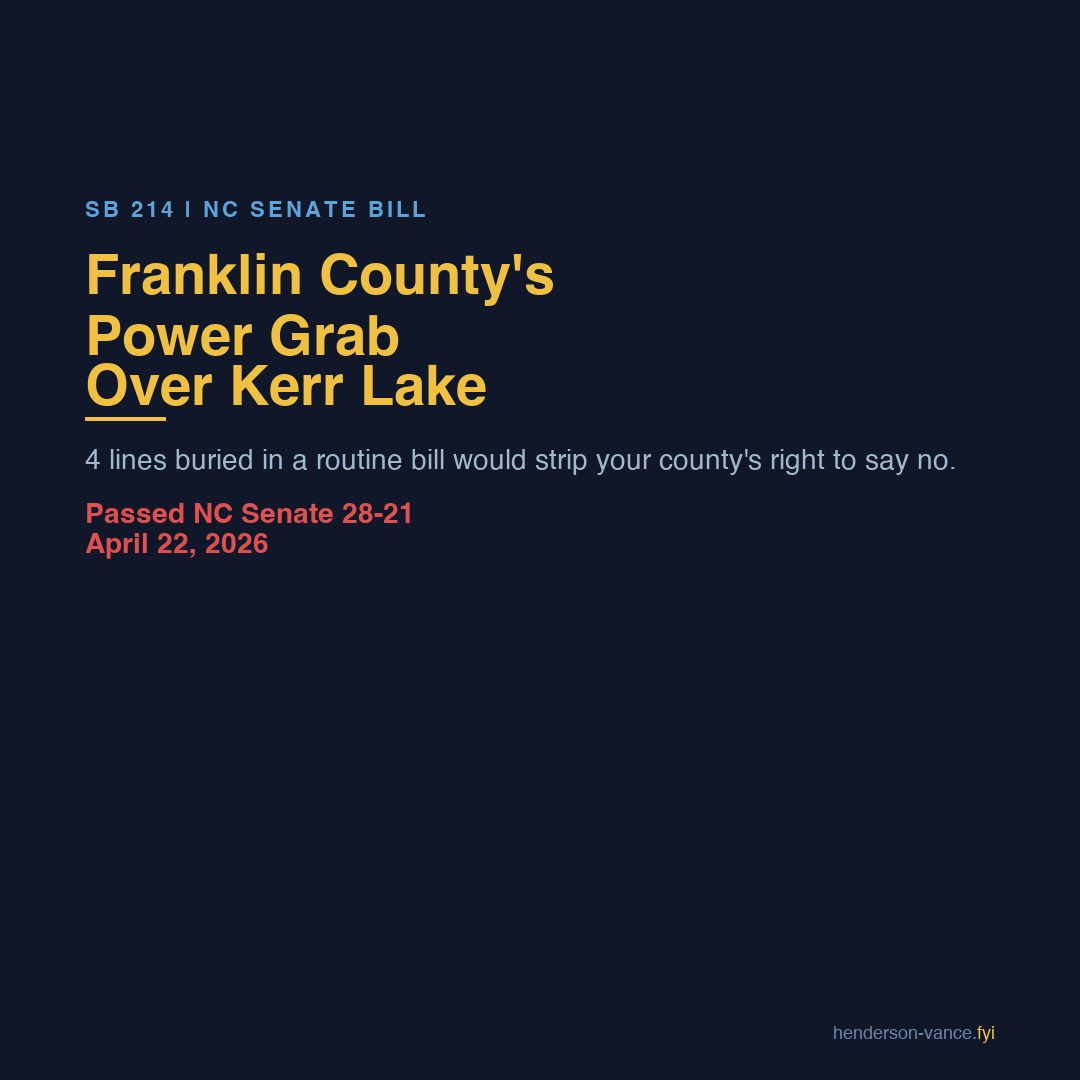
Senate Bill 214, titled "Various Local Provisions VII," is an omnibus local government bill that passed the NC Senate on April 22, 2026. Buried inside it was Part V, Section 5: Franklin County Property Acquisitions, a four-line provision that would have stripped Vance, Warren, and Halifax Counties of their legal right to approve or deny property acquisitions by Franklin County within their borders. After regional opposition, Section 5 was removed on April 29.
Source: NC General Assembly, SB 214 Conference Committee Substitute, S214-PCCS35356-BAxr-6, Page 2, Lines 33-37
The Exact Language
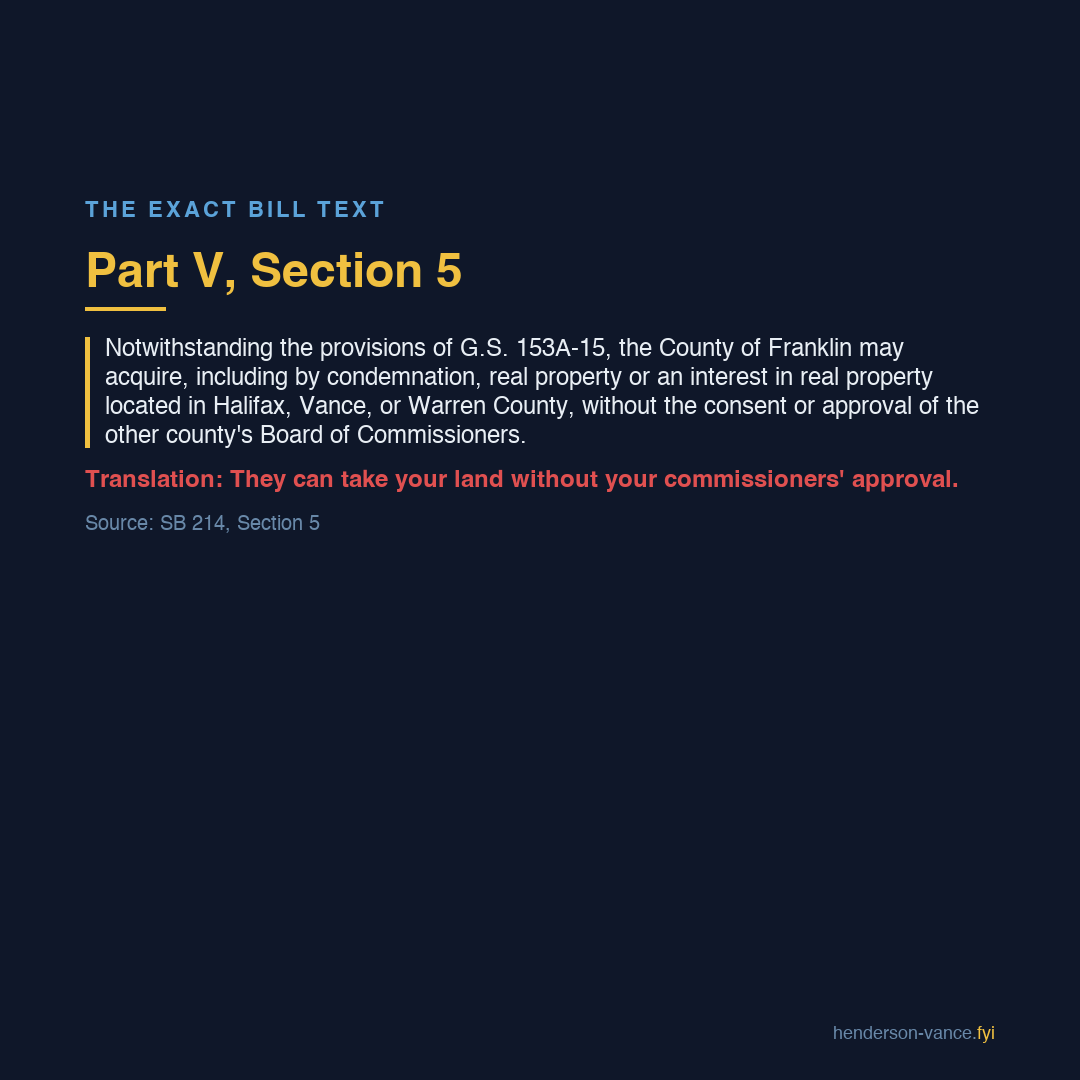
"Notwithstanding the provisions of G.S. 153A-15, the County of Franklin may acquire, including by condemnation, real property or an interest in real property located in Halifax, Vance, or Warren County, without the consent or approval of the other county's Board of Commissioners."
Source: SB 214, Section 5
What G.S. 153A-15 Protects
North Carolina General Statute 153A-15 requires any county seeking to acquire or condemn property in another county to first obtain consent from that county's Board of Commissioners. This law protects counties from losing tax base and regulatory authority when outside governments take property within their borders. Part V of SB 214 overrides this protection for Franklin County's benefit.
How It Passed the Senate
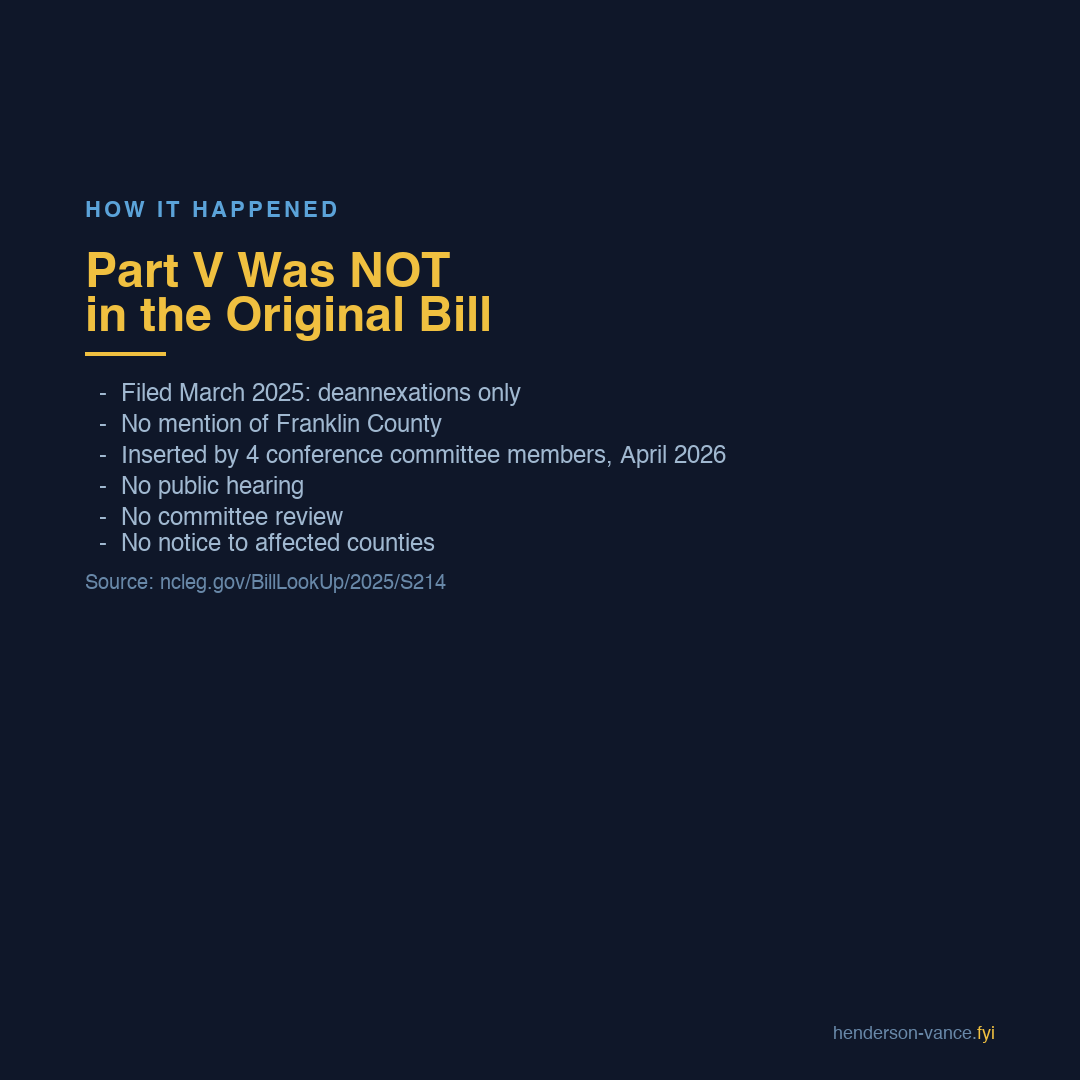
Part V was not in any version of SB 214 before the conference committee. The original bill, filed March 3, 2025, dealt only with deannexations in Southport, Yadkinville, and Kannapolis. The Franklin County provision was inserted during conference committee in April 2026, added to a routine bill where it would attract minimal public attention.
28-21
Party-line vote, April 22, 2026
4 people
Conference committee wrote Part V
Every Republican voted Yes. Every Democrat voted No.
Source: Roll Call #502
Sponsor: Senator Benton Sawrey (R), District 10, Johnston County.
Conference Committee: Sen. Sawrey (Chair), Sen. Dana Jones (R), Rep. Allen Chesser (R, Chair), Rep. Mike Schietzelt (R).
Senator Barnes Voted Yes
Senator Lisa S. Barnes (R), District 11, represents both Franklin County and Vance County. She voted Yes on a bill that benefits Franklin County while stripping protections from Vance County, one of the counties she is elected to represent.
Senator Norman Sanderson (R), District 2, represents both Halifax and Warren Counties. He was the only Republican to vote No.
Rep. Bryan Cohn Spoke Against It
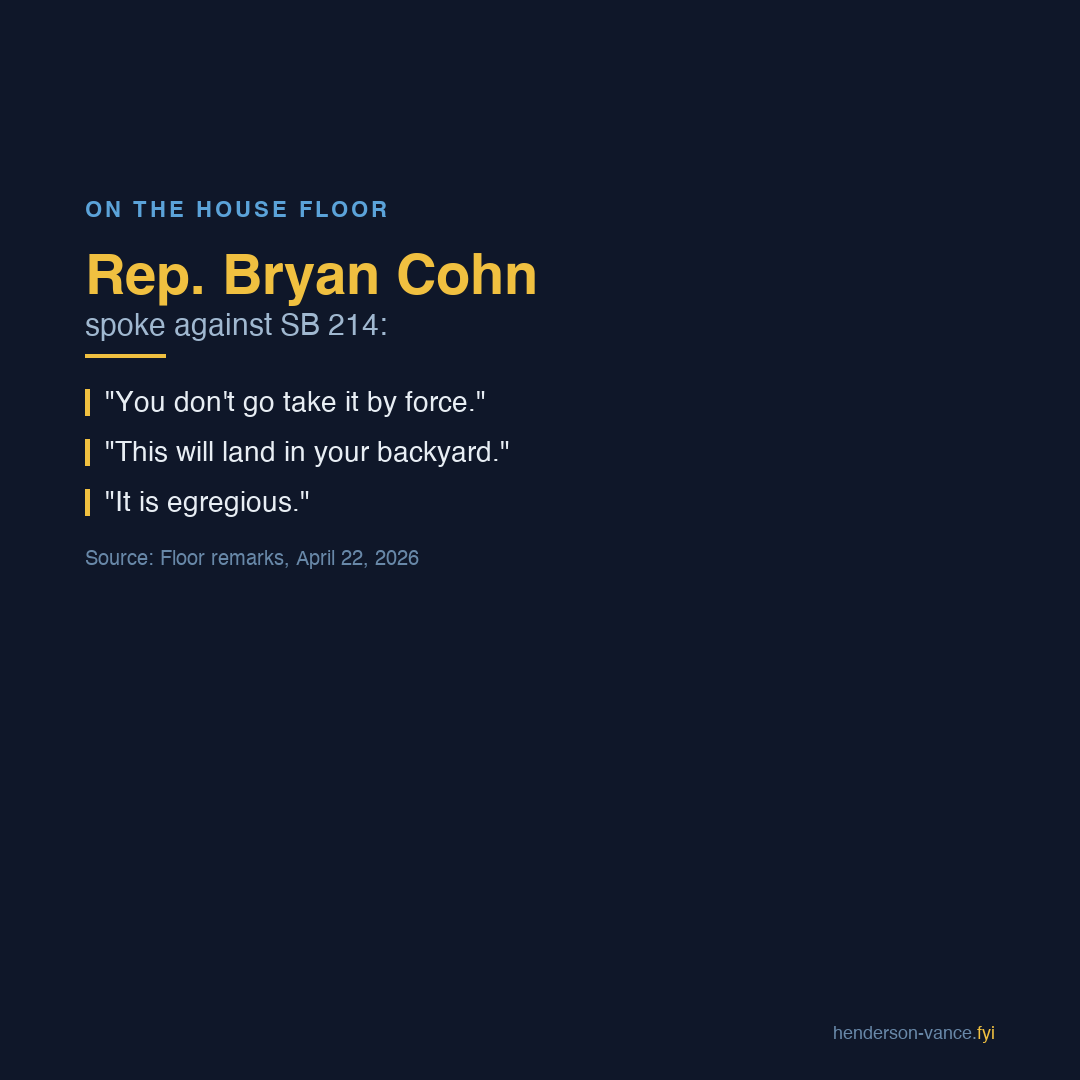
Representative Bryan Cohn (D), District 32, represents Granville and Vance Counties. He spoke on the floor against SB 214, stating he had been on the phone since 7:14 that morning with colleagues across his district who knew nothing about the provision.
"This bill and this provision is about taking control. It allows one county to assert control over another without those local leaders' consent in those affected communities."
"We often make a big deal in this chamber about protecting the rights of local governments and local elected officials, and this goes right in the face of those positions we have taken in the past."
"Local control belongs with local government and we are overstepping our bounds as a body by voting for this."
"Take the reasoning out of it. This will not stop at Warren, Vance, and Halifax County. This will land in your backyard. We are setting a dangerous precedent by allowing one county to assert control over another."
"If you want to be able to develop infrastructure that affects multiple counties and allows for growth and prosperity across the region, then work together in partnerships. You don't go take it by force."
"This is what this is leading to, the takeover of water infrastructure that is owned by majority and minority communities, and has been for many, many decades."
"Let's rework it and bring it back, but I cannot stand for this bill. It is egregious."
Source: Rep. Bryan Cohn, floor remarks, April 22, 2026
Rep. Rodney Pierce Called It "Manifest Destiny"
Representative Rodney Pierce (D), District 27, represents Halifax, Northampton, and Warren Counties. He spoke on the floor against SB 214 during the Wednesday session before Speaker Hall pulled the bill.
"This straight-up sounds like Manifest Destiny. We just say this is what we want in your county, and we take it."
"This bill is no longer what it started as. It has become a vehicle for overreach, stripping rural counties of their rights."
"When legislation that impacts land, water and development aligns this closely with a lawmaker's private business interests, the public deserves transparency and accountability."
"This bill is about more than deannexation. It's about who controls our land, our water, and our future."
Sources: WRAL, Roanoke Rapids Daily Herald, CMG Plus
Republican Leadership Opposed It Too
Deputy Majority Whip Howard Penny Jr. (R), District 53, represents Harnett County and is a former county commission chair. He spoke with citizens from Vance County at the General Assembly on April 28 and was unequivocal in his opposition.
"I'm not gonna support that. I live with a bank of Cape Fear River. We got a Harnett regional water. And we can't - anybody want to buy it, they share in the plant, the lines, the process. Franklin County needs to get their hands in their pocket and go find a partner that will work with them."
"He hijacked the bill. The bill was basically a clean de-annexation bill. Had nothing to do with this. And then he went in, hijacked the bill, and put that verbiage in there for Franklin County."
"Think about the impact on all 100 counties if one county is allowed to do this, and you're on a lake or tributary that's got water. You can't put that genie back in the box."
"Basic way a conference report works up here - you take members from the Senate, members from the House, and the conferees come together. Most of the time, we don't take the time to read it because it's been through conference, we assume everything was worked out. In this case, we didn't know this language was added into it."
Source: Conversation with citizens from Vance County, NC General Assembly, April 28, 2026
Former Rep. Sossaman: Still Fighting From the Outside
Former Representative Frank Sossaman (R), who represented Granville and Vance Counties, has been working behind the scenes to stop SB 214 even out of office, spending hours contacting current representatives and the Speaker. In an interview on April 28, he laid out why Section 5 is dangerous.
"If this would come into law today, they go after water. Tomorrow, they go after natural resources. And the next day, they go after a landfill. They don't want a landfill in their county, so they'll go to Vance County and get property and have their landfill over here. This right here is just the beginning of a snowball."
"What the federal government and the state really wants to happen across North Carolina is to have regional water systems. The federal government has money appropriated for those regional water systems. It also has grant money it can award."
"If it becomes a regional water system, the system would pay Henderson what it has invested. It wouldn't be a burden on just one person, it would be a collective deal. Then Henderson could take that money and invest in economic development, in infrastructure, and really moving Henderson forward."
"A lot of times you trust leadership who is guiding a bill along. You read over it, but you don't do a deep dive. Good faith. But when they started looking closer at the language - no, no, this can't be. This is opening Pandora's box."
Source: Interview with Charles Turrentine Jr., April 28, 2026
Rep. Winslow's Response
Representative Matthew Winslow (R), District 7, represents Franklin County and part of Vance County. He has announced he will not seek re-election.
"It's very narrowly tailored so that it's only giving access to water resources to Franklin County."
Source: WRAL, April 26, 2026
Note: The bill's actual language contains no limitation to water infrastructure. It authorizes condemnation of any "real property or an interest in real property." Henderson City Manager Paylor Spruill warned it could apply to the KLRWS facility, transmission lines, or even county courthouses.
The Region Is Pushing Back
Within days of Part V becoming public, county governments across the region began passing formal resolutions opposing SB 214. Every county named in the bill has taken official action. Not a single governing body has spoken in support.
Halifax County Board of Commissioners
Held an emergency meeting and unanimously approved a resolution opposing SB 214. More than 300 people attended. Not a single speaker supported the bill.
Chairman Vernon J. Bryant personally contacted every municipality in the county to request opposition resolutions and is reaching out to Halifax Horizons, the Economic Development Commission, the Intergovernmental Association, Roanoke Rapids Sanitary District, and the Upper Coastal Plains Council of Governments. Halifax County is organizing two buses to the NC General Assembly on April 28.
Warren County Board of Commissioners
Held an emergency meeting on April 24 at the Warren County Armory Civic Center and unanimously approved a resolution opposing SB 214 Section 5.
Source: The Warren Record
Vance County Board of Commissioners
Chairperson Carolyn Faines called an emergency meeting on April 24. The board voted unanimously to oppose SB 214, Part V, Section 5.
City of Henderson
The City of Henderson, which controls 60% ownership of the Kerr Lake Regional Water System, is holding an emergency meeting in opposition to SB 214. Mayor Melissa Elliott has spoken out against the bill.
Granville County Board of Commissioners
Sent a formal letter of opposition on April 7, weeks before Part V was even inserted into SB 214, opposing Franklin County's request to the Army Corps for a direct Kerr Lake water allocation.
Town of Warrenton Board of Commissioners
Unanimously approved a resolution on April 15 opposing Franklin County's request to the Army Corps, supporting positions outlined in Granville County's opposition letter and the KLRWS Board's position on maintaining system integrity and equitable cost distribution.
Source: The Warren Record
Haliwa-Saponi Indian Tribe Tribal Council
The state-recognized tribal nation, whose citizens primarily live in Halifax, Franklin, and Warren Counties, adopted a formal resolution opposing SB 214 Section 5. Vice Chairman Earl Evans spoke at the April 28 press conference, noting the tribe was never consulted despite being directly impacted.
Roanoke Rapids Sanitary District
An independent governmental entity created under state law, the Sanitary District adopted a resolution opposing the provision. Their attorney, Melissa Dixon, a board-certified real estate law expert, argued at the press conference that Section 5 was illegal under Article 2 of the NC Constitution, citing City of Asheville v. State of NC (2016).
What Local Leaders Are Saying
"Totally disrespectful... as low as you can go."
Halifax County Chairman Vernon J. Bryant (Daily Herald)
"Robbery... unethical."
Vance County Chairperson Carolyn Faines (Henderson Dispatch)
"Water is life, land is legacy, and justice belongs to poor people too. You cannot take our land, you cannot take our water, and you cannot take our future."
Henderson Mayor Melissa Elliott (Press Conference, April 28, 2026)
"I have never seen such legislation in 40 years of local government work."
Halifax County Attorney Glynn Rollins (Daily Herald)
"This provision could affect the KLRWS facility, transmission lines, or even county courthouses."
Henderson City Manager Paylor Spruill (Henderson Dispatch)
Eight governing bodies across four counties, plus a tribal nation and an independent sanitary district. Zero in support. This was not a partisan issue. It was a regional consensus that Section 5 was wrong, and the affected communities deserved a voice. They used that voice, and Section 5 was removed.
News Coverage
SB 214 Section 5 drew statewide and national attention. Here is every major report we have found, linked directly to the source, from the initial backlash through the removal.
WRAL
Protesters flood legislature to oppose land-grab bill over water access→
Staff | April 28, 2026
Yahoo News (National)
NC lawmakers scrap eminent domain provision in bill after outcry from local leaders→
AP / Staff | April 29, 2026
WUNC (NPR)
Neighboring counties push back on Franklin County effort to obtain property for water plant→
Staff | April 28, 2026
Roanoke Rapids Daily Herald
Senate strips controversial provision from SB 214 after regional backlash→
Staff | April 29, 2026
Henderson Dispatch
Lawmakers remove Section V from SB 214→
Staff | April 29, 2026
Carolina Journal
Bill on Franklin County water leads to debate on local authority→
Staff | April 2026
Carolina Public Press
Franklin County water grab, Forsyth school board topics of NC bill→
Staff | April 2026
The Warren Record
State Rep. Pierce condemns Senate Bill 214, calls it 'A direct threat to rural counties and local control'→
Staff | April 2026
WRAL
Water wars: Booming population, drought driving tension in NC statehouse and beyond→
Will Doran | April 26, 2026
RRSpin
Speakers band together to oppose SB 214→
Staff | April 28, 2026
RRSpin (Opinion)
A land grab nobody saw coming→
James David Gailliard | April 27, 2026
RRSpin
Franklin County responds to proposed Senate bill→
Staff | April 2026
NC Tribune
Could Franklin Co. grab Henderson's water plant?→
Staff | April 26, 2026
Henderson Dispatch
Local leaders rallying against SB214→
Tyler Davis | April 24, 2026
Roanoke Rapids Daily Herald
Halifax County pushes back against bill allowing cross-county land seizures→
Richard Holm | April 23, 2026
Roanoke Rapids Daily Herald
Rep. Pierce opposes SB 214, cites concerns over local control→
Staff Reports | April 24, 2026
Roanoke Rapids Daily Herald
Roanoke Rapids joins Halifax in opposing bill allowing outside county to seize land→
Staff | April 2026
CMG Plus / WPTF / 96.1 BBB (Syndicated)
Senate proposal sparks local backlash over property, water control concerns→
Laura Gabel & John C. Rose | April 24, 2026
The Warren Record
Warrenton board unanimously approves resolution opposing request→
Staff | April 15, 2026
The Warren Record
Three citizens ask county commissioners for formal opposition→
Staff | April 2026
Know of coverage we missed? Share it with us at the signup form below.
Legal Precedent: They Tried This Before
Asheville Water System (2013-2016)
In 2013, the NC General Assembly passed House Bill 488, forcing the City of Asheville to transfer its entire water system to a regional authority. The system included 40 pumping stations, 1,600 miles of pipe, and 124,000 customers. Asheville had operated it for over 100 years.
Asheville sued. After a three-year legal battle, the NC Supreme Court ruled 5-2 that the forced transfer was unconstitutional, citing Article II, Section 24 of the NC Constitution, which prohibits local acts "relating to health, sanitation, and the abatement of nuisances."
Justice Sam Ervin IV wrote that the forced transfer was "not a valid exercise of sovereign power of legislative branch of government to take or condemn property for a public use."
44 cities and towns filed briefs or resolutions supporting Asheville, recognizing that if the legislature could take one city's water system, it could take anyone's.
Sources: NC Newsline, Mountain Xpress, FindLaw: City of Asheville v. State (2016)
Why This Matters for SB 214
Rep. Cohn called Part V "grossly unconstitutional." The Asheville ruling established that the NC legislature cannot use local acts to forcibly transfer water infrastructure between local governments. SB 214 Part V goes even further, granting one county eminent domain power over another county's land without consent.
The same constitutional provision, Article II, Section 24, that struck down the Asheville seizure applies here. If the legislature could not take Asheville's water system, it cannot give Franklin County the power to take Henderson's.
Senate Bill 320 (2019): The First Attempt
This is not the first time the legislature has been used as leverage over Kerr Lake water. In 2019, Senate Bill 320 would have required the state to withhold $18 million in federal grants for the KLRWS expansion until every local government filed a rate agreement, or waived their right to one. The bill was widely seen as a tool to pressure Henderson on behalf of Franklin County.
The Senate passed SB 320 on a party-line vote, 20-17. Governor Roy Cooper vetoed it, warning that local governments should not use state laws to gain the upper hand in negotiations over vital resources like water.
Sources: WRAL (2019), NC General Assembly: SB 320
A Pattern
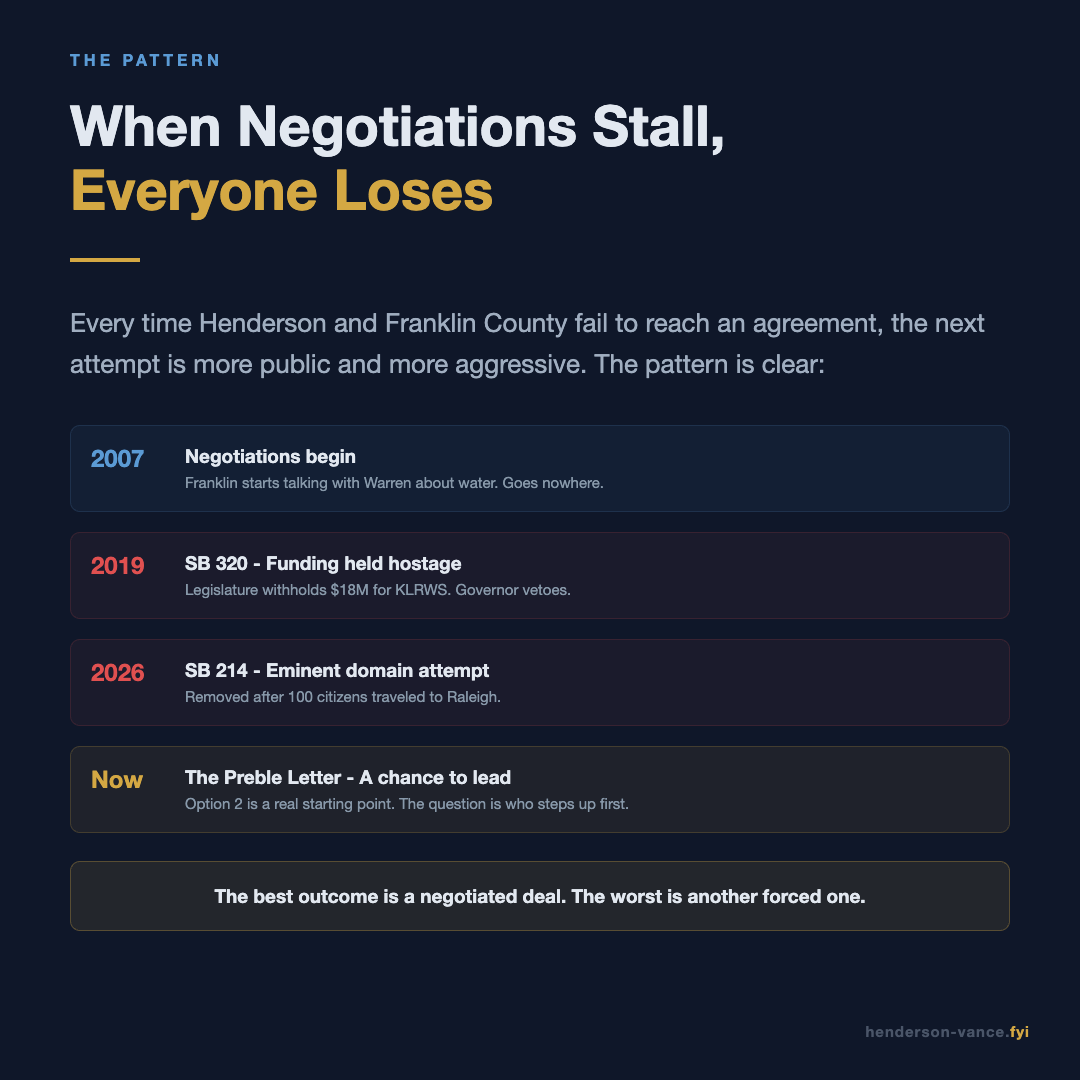
2019: Use the legislature to hold KLRWS funding hostage. Vetoed. 2026: Use the legislature to strip counties of their consent rights. SB 214 Part V is the second time in seven years that the General Assembly has been asked to override local control of Kerr Lake water on Franklin County's behalf. The method escalates each time.
Why: Franklin County Wants Kerr Lake Water
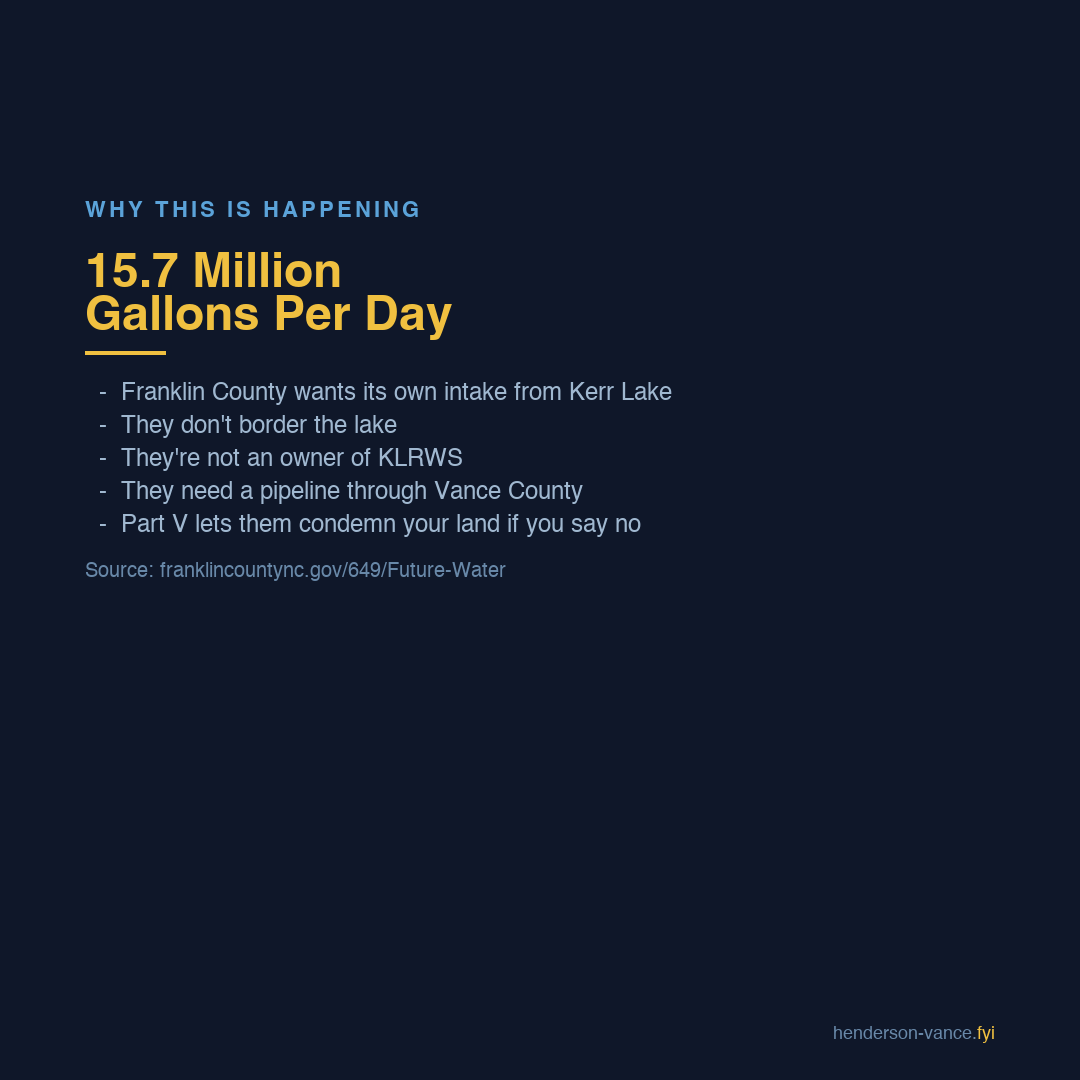
Franklin County does not border Kerr Lake. It is not an owner of the Kerr Lake Regional Water System. It currently purchases treated water through the City of Henderson. But Franklin County is pursuing an independent water intake directly from Kerr Lake, requiring a pipeline through Vance County. Part V gives them the power to condemn land for that pipeline even if Vance County says no.
The Facts (from Franklin County's Own Website)
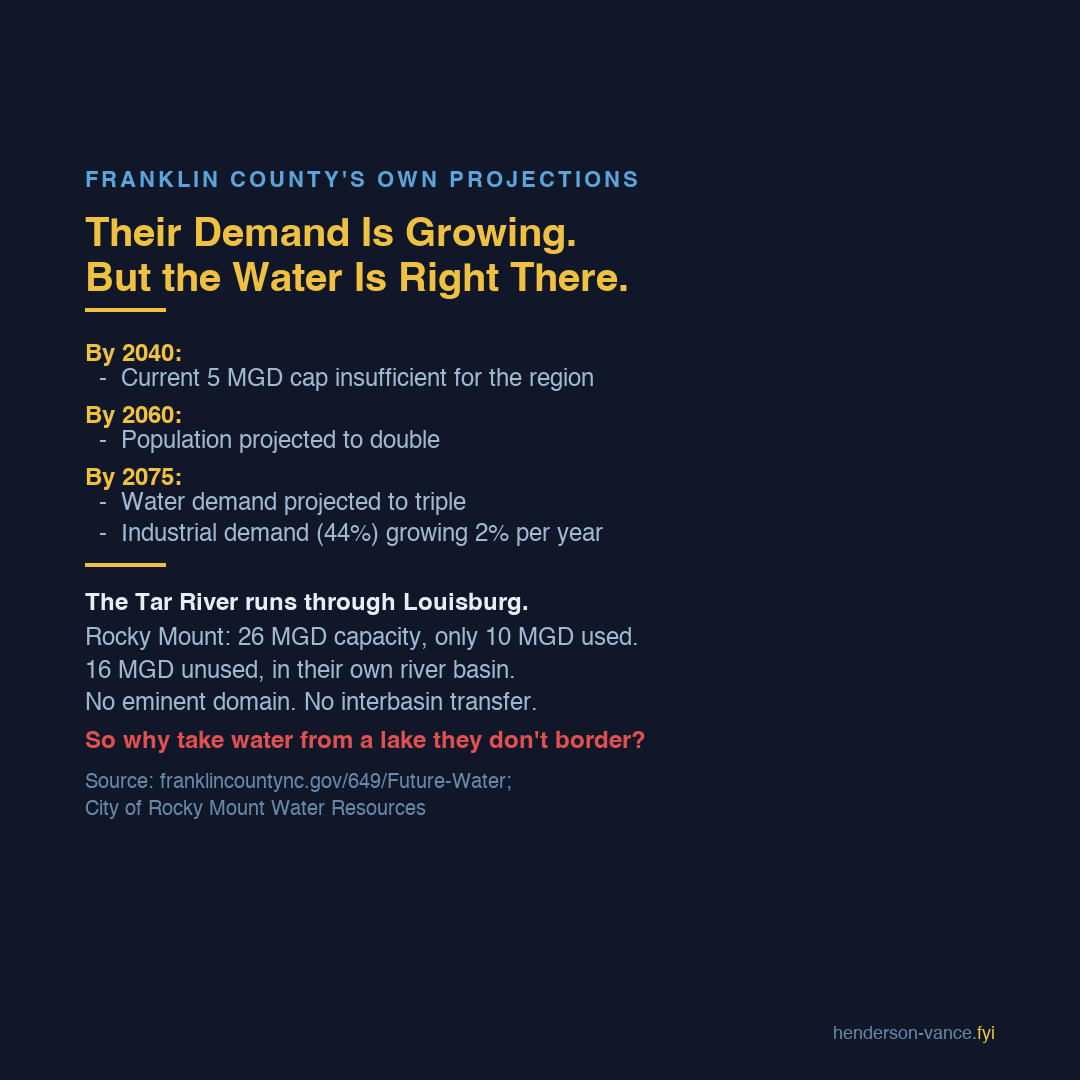
- Population projected to double by 2060; water demand projected to triple by 2075.
- Industrial customers account for 44% of current water demand.
- Requesting 15.7 million gallons per day (10,200 acre-feet) from Kerr Lake.
- Feb. 2025 engineering study: $78.9 million pipeline from Vance to Franklin County.
- $200 million RFQ for public-private water plant and pipeline (Sept/Oct 2025).
- $2 million agreement with Army Corps to fund reallocation study (Aug 2025).
- Henderson declined repeated requests for additional supply (2020-2024).
- Current water contract with Henderson through KLRWS expires in 2038.
All facts above sourced from franklincountync.gov/649/Future-Water
The Kerr Lake Regional Water System
- KLRWS is owned by Henderson (60%), Oxford (20%), and Warren County (20%). Franklin County is not an owner.
- Army Corps granted KLRWS a 20 MGD annual average day allocation in 2005.
- Treatment plant expanding from 10 MGD to 20 MGD, cost exceeding $109 million.
- NC HB 74 attempted to redirect $10M in KLRWS expansion funding, including $3M to Franklin County.
- If Franklin County leaves the system, remaining partners absorb the lost revenue.
The Interbasin Transfer Problem
Kerr Lake sits in the Roanoke River Basin. Franklin County sits in the Tar River Basin. Any water moved from Kerr Lake to Franklin County is an interbasin transfer, requiring a separate certificate from the NC Environmental Management Commission. The existing KLRWS certificate authorizes 14.2 MGD total. Franklin County's additional 15.7 MGD would exceed current limits.
A Better Path Forward: Work Together
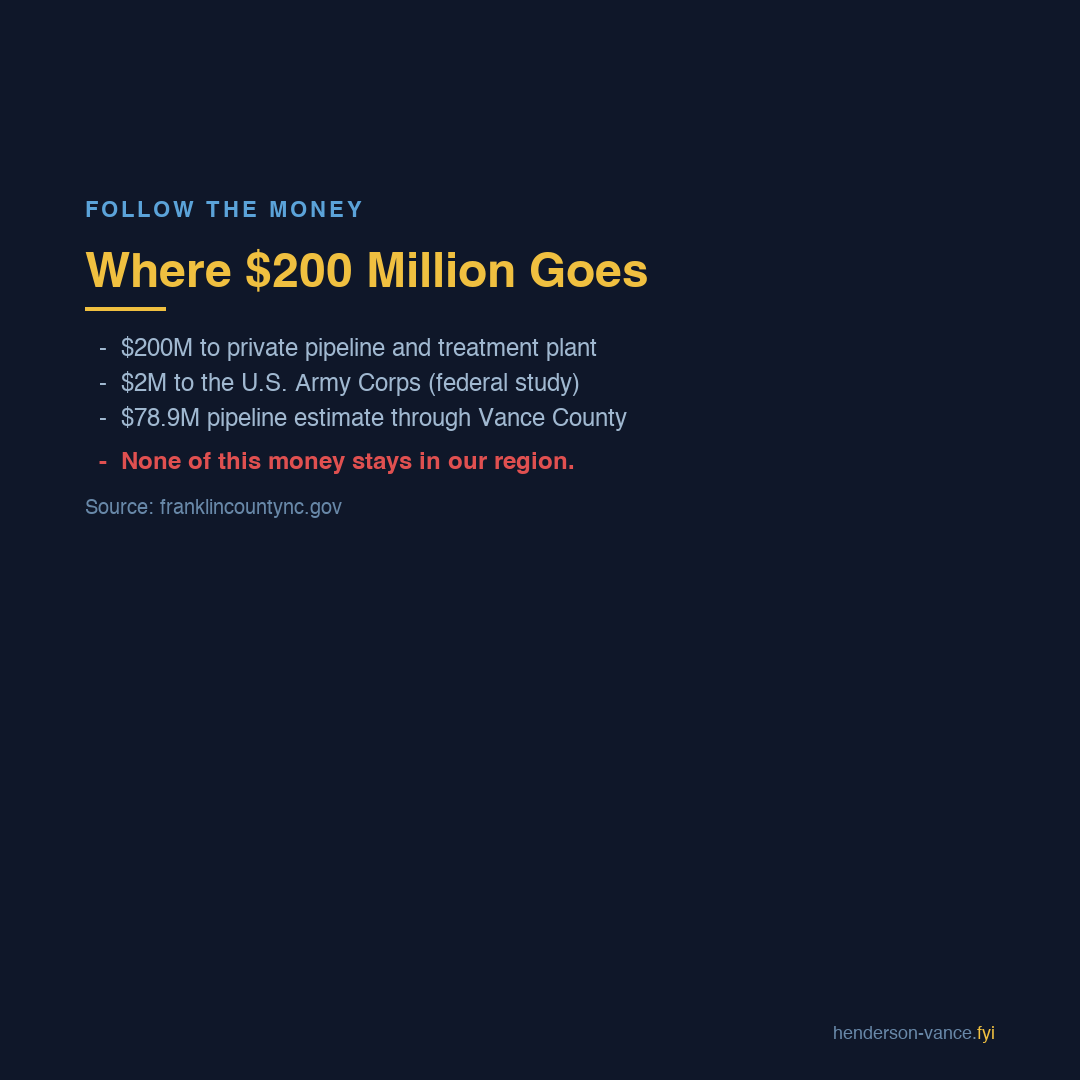
Franklin County has a real water challenge. No one disputes that. But the solution should strengthen the region, not divide it. Right now, Franklin County is preparing to spend over $200 million on a private pipeline and a new water plant, plus $2 million on a federal Army Corps study. That money flows to private contractors and the U.S. Treasury. It does not benefit Henderson, Vance County, Warren County, or the Kerr Lake Regional Water System.
The Best Option: Invest in KLRWS
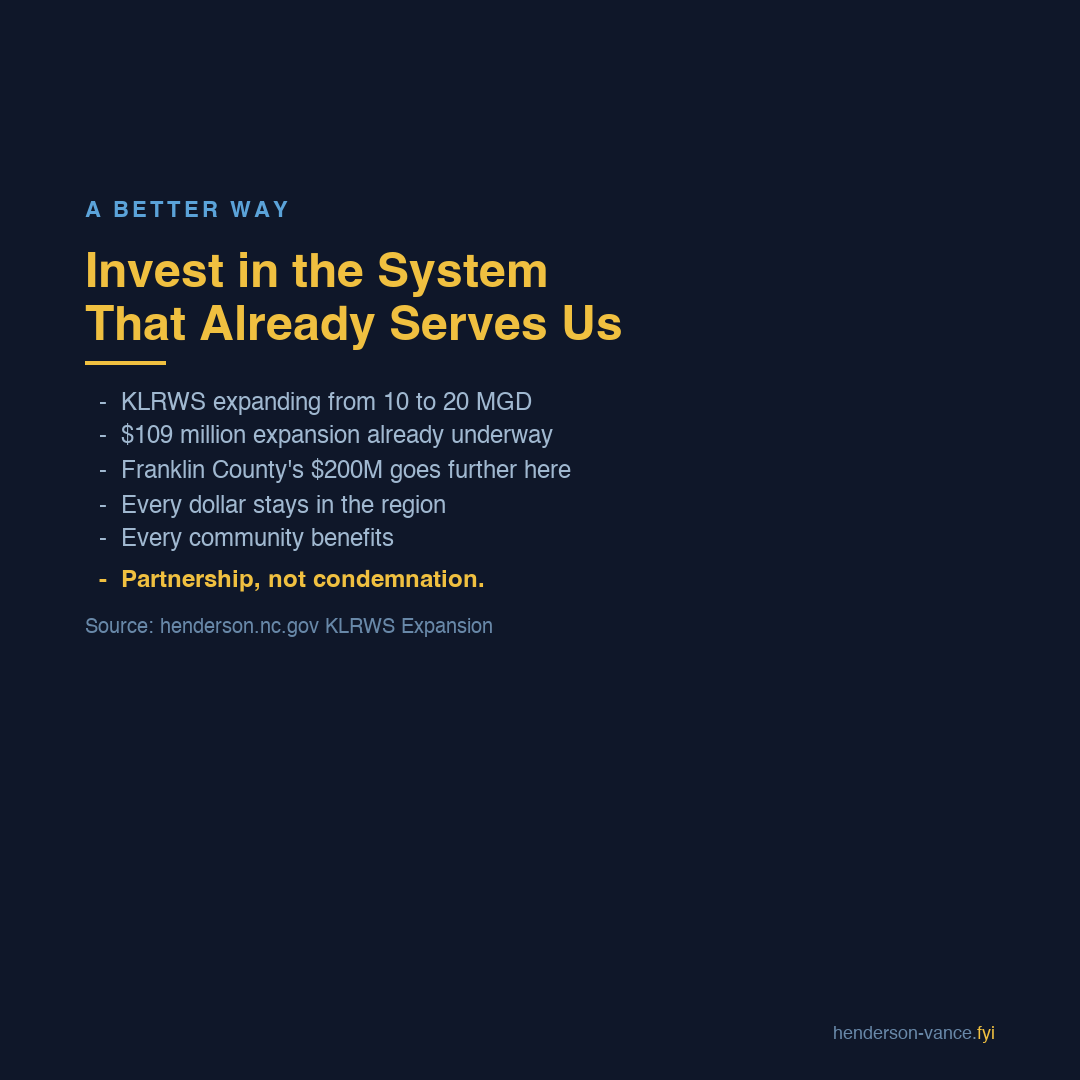
The KLRWS has served this region for nearly 50 years. Rather than abandoning this system, Franklin County should be strengthening it. A regional partnership where everyone invests and everyone benefits is the right answer.
- Strengthen KLRWS (already expanding from 10 to 20 MGD) rather than creating a competing system.
- Keep dollars in the region instead of sending $2M to the Army Corps and $200M to private developers.
- Eliminate the need for eminent domain. No pipeline, no condemnation, no override of G.S. 153A-15.
- Avoid the interbasin transfer problem. Purchases through KLRWS are already covered by the existing IBT certificate.
- Protect the financial stability of the system. If Franklin County leaves, remaining partners absorb the loss.
- Maintain good-faith relationships between neighboring counties.
Franklin County's $200 million would go further invested into a system that already exists, already works, and already serves them. With Franklin County as a committed partner rather than a departing customer, the system could be expanded even further. Every dollar stays in the region. Every community benefits. That is how neighboring counties are supposed to work together.
The Tar River Runs Through Franklin County
The Tar River flows directly through Louisburg, Franklin County's county seat. Rocky Mount's water system has 26 MGD capacity but uses only about 10 MGD, leaving roughly 16 MGD of unused capacity, nearly the exact amount Franklin County is requesting from Kerr Lake.
If the water Franklin County needs is available 30 miles away in its own river basin, with no eminent domain, no interbasin transfer, and no federal study required, why is the state legislature being asked to strip property protections from three neighboring counties so Franklin County can take water from a lake it does not border?
The Resale Concern
Nothing in Part V restricts what Franklin County does with the water or property it acquires. Once Franklin County controls a 15.7 MGD independent intake and its own $200 million treatment plant, it becomes a wholesale water provider. Franklin County already resells water to Youngsville, Bunn, and Lake Royale. The counties whose land gets condemned for the pipeline do not see a dime of that revenue.
In Fairness: Franklin County Has Real Needs
This is not about denying Franklin County water. Their challenge is real and it is documented. According to Franklin County's own public filings:
- Franklin County made "repeated written and verbal attempts to purchase additional water from the KLRWS through Henderson" over four years.
- The current infrastructure is "capped at 5 million gallons per day" and "will be insufficient to meet the projected demand of Franklin County and the region by 2040."
- Even expanding the existing pipe at $50M+ "will not provide the capacity needed to meet the demand of the region."
- Franklin County adopted a 2017 ordinance limiting new connections. They have been managing this crisis responsibly.
All quotes sourced from franklincountync.gov/649/Future-Water
Franklin County's Own Chair Didn't Know
The Herald reached out to Chairwoman Roxanne Bragg of the Franklin County Board of Commissioners about what prompted the legislative move.
"Well, we need water - that's what prompted it. The bottom line is we need to get water in Franklin County, and we're doing what we can do to get water."
When asked whether it was morally and ethically right to bypass the consent of county commissioners, Bragg said she did not know anything about that. After being read the provision, Bragg deferred to Franklin County Attorney Gena McCray, who could not be reached by deadline.
The chairwoman of the county this provision was written for did not know it bypassed neighboring counties' consent. That tells you everything about how Part V was created.
Source: The Herald, April 24, 2026
A Call to Our Own Leaders
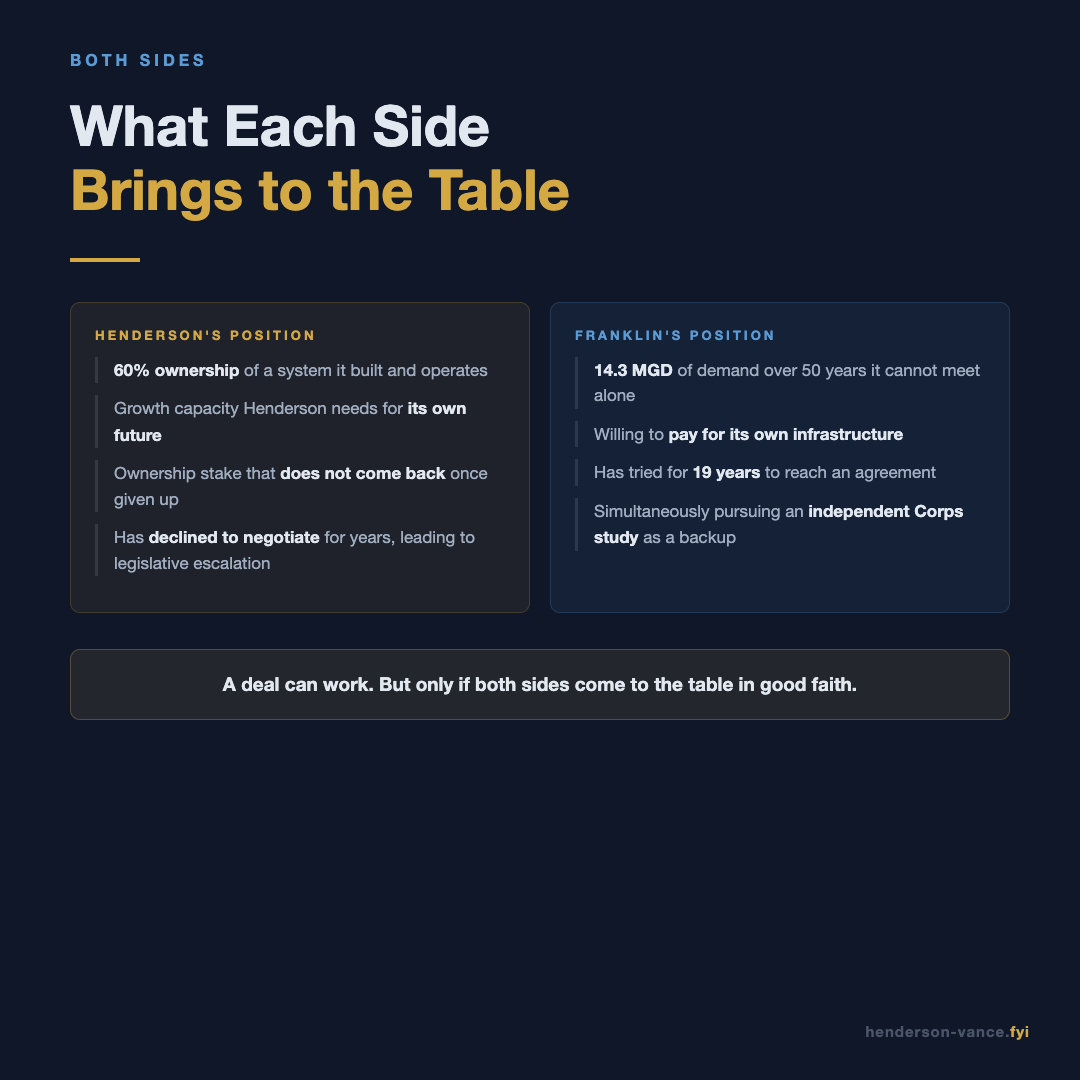
If Franklin County has been asking for more water for four years and the answer has been no, then our leaders in Vance County and Henderson need to come to the table too. Henderson controls 60% of KLRWS. That comes with responsibility to every community the system serves, including Franklin County.
We are calling on the Vance County Board of Commissioners, the Henderson City Council, and the KLRWS partners to proactively engage Franklin County in good-faith negotiations for a regional solution. Expand the system. Renegotiate the terms. Find a partnership that works for everyone. Do it before the state legislature does it for you, on terms that benefit no one in this region.
The door should be open. But it should be a door, not a battering ram. SB 214 Part V is a battering ram. The alternative is neighbors sitting down at the same table and solving this together, the way it should have been done from the start.
May 21, 2026
The Next Move: Franklin County's Formal Demand
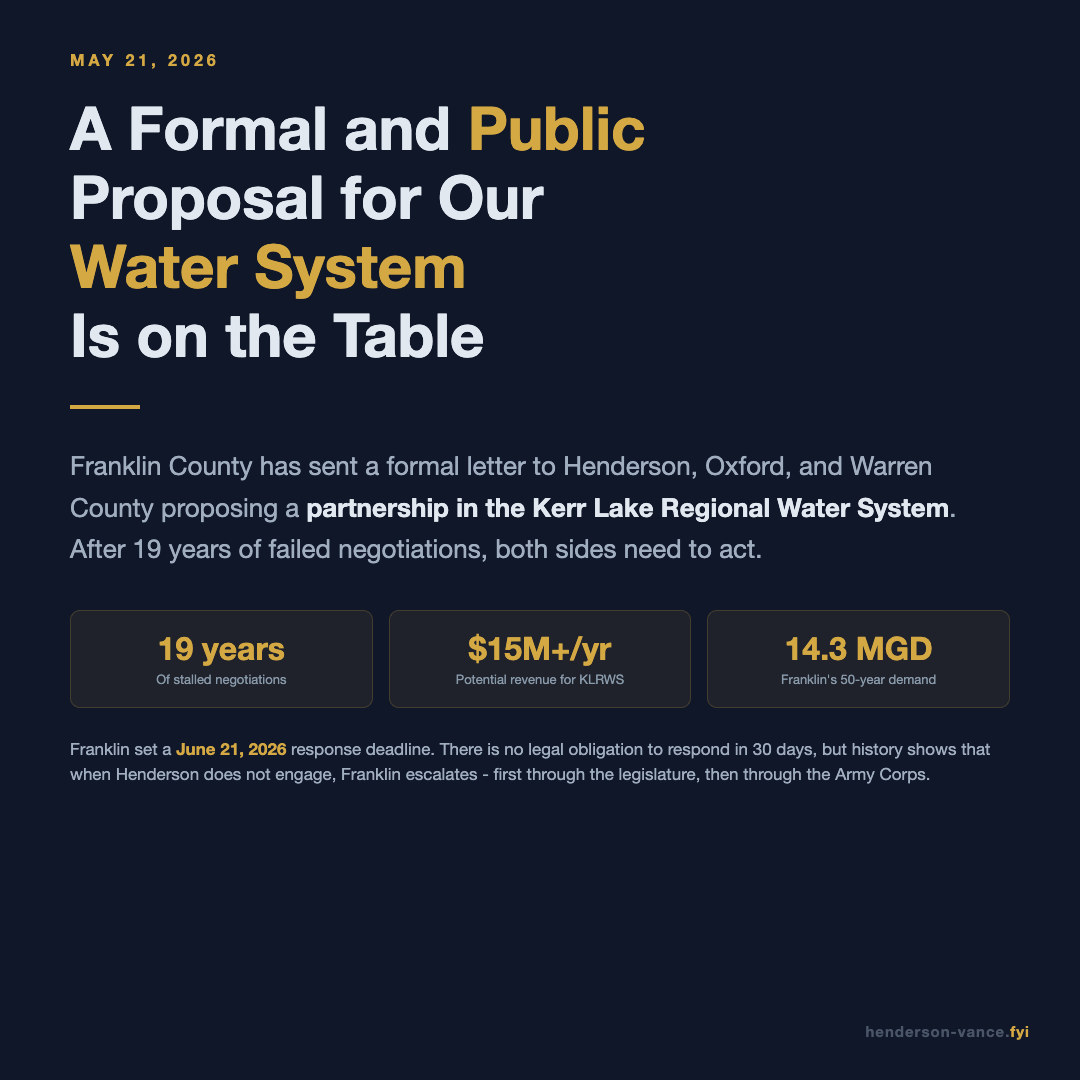
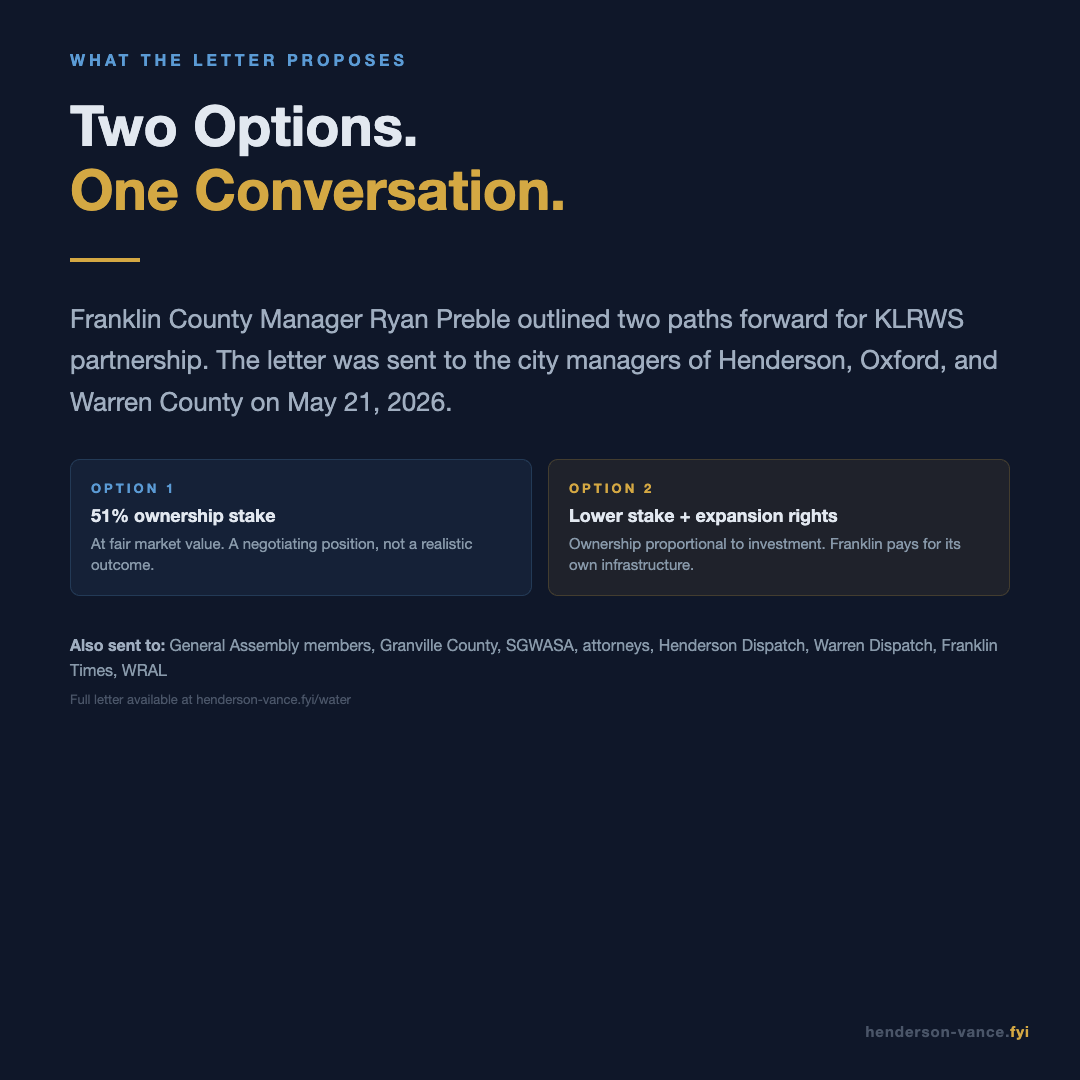
Three weeks after SB 214 Section 5 was removed, Franklin County Manager Ryan C. Preble sent a six-page letter to the city managers of Henderson, Oxford, and Warren County. The letter was also sent via email and U.S. Mail to members of the General Assembly, Granville County, South Granville Water and Sewer Authority (SGWASA), two attorneys, and four media outlets including WRAL, the Henderson Dispatch, the Warren Dispatch, and the Franklin Times.
This is not a private negotiation. The letter was made public from the moment it was sent. Below is our analysis of every claim in the letter, verified against public records, regulatory filings, and the facts we have compiled over the past three months.
Read the Full Letter
6 pages. From Franklin County Manager Ryan C. Preble to the city managers of Henderson, Oxford, and Warren County. Dated May 21, 2026.
Download Letter (PDF)What the Letter Demands
Franklin County presents two options and asks for a signed response by June 21, 2026 (30 days). The letter includes signature lines for all three recipients.
Option 1
Sell Franklin a 51% stake in KLRWS at fair market value.
This would give Franklin County majority ownership and control over the water system that Henderson built and has operated for over 50 years. Henderson currently holds 60%.
Option 2
Sell Franklin a lower percentage with the right to expand at Franklin's cost.
Franklin would receive an ownership stake proportional to its financial investment, plus the right to develop additional capacity within KLRWS at its own expense.
Franklin County's Challenge (From the Letter)
The letter documents a 19-year history of Franklin County seeking long-term water supply. These facts come directly from the letter and are verifiable against public records:
- Franklin County has 5.5 MGD in water supply from Henderson, Raleigh, and the Franklinton plant. It has already allocated 4.082 MGD.
- If demand were measured as annual average instead of maximum daily, Franklin would exceed the 80% Rule (R.61-58.7C(12)), triggering a freeze on new water allocations.
- Franklin receives applications for 120,000 GPD per year but can only award 75,000 GPD. The queue for allocation is approximately two years.
- Franklin's updated 50-year Master Plan (at the request of the Army Corps) shows a need for 14.3 MGD of finished water and 15.7 MGD of raw water.
- Rocky Mount and Wilson both declined to sell water to Franklin County.
- The existing 24-inch pipeline from KLRWS can only convey 5 MGD. Henderson would need to sell 67% of its supply and upgrade its entire distribution system to serve Franklin.
- Franklin engaged the Army Corps for a Kerr Lake reallocation study, which began in December 2025. The draft report is expected September 2027.
Source: Letter from Ryan C. Preble, Franklin County Manager, May 21, 2026. Read the full letter (PDF)
19 Years of Attempts (From the Letter)
The letter documents Franklin County's history of seeking water partnerships. This timeline is drawn directly from the letter's claims:
- 2007: Franklin begins talking with Warren County about purchasing water. Warren's engineers (Rivers and Associates) study connecting the systems.
- 2021-2022: Franklin holds discussions with Warren, Vance, and Granville about installing distribution infrastructure. Offers $750,000 per county ($150K on signing, $100K on permitting, $225K during construction, $275K on permit issuance) plus $0.05/1,000 gallons with a 0.025% annual escalator.
- Warren was unwilling to let Franklin install lines without Henderson's consent. Vance said no unless Henderson consented. Henderson did not consent.
- Discussions with Granville and SGWASA evolved into an $8.55 million joint project, but SGWASA would only consider a swap of water and sewer services. The deal fell through.
- After Granville/SGWASA talks collapsed, their legal counsel offered two legislative proposals (including one in 2023 that required $50M from the General Assembly). Franklin did not support either because neither met its long-term needs.
- Henderson City Attorney Rix Edwards asked Franklin for a term sheet. Franklin's terms: either a 51% stake or, at minimum, some ownership plus the ability to expand KLRWS capacity at Franklin's cost.
- Both City Manager Terrell Blackmon and his successor Hassan Kingsbury declined short-term supply increases and did not agree to Franklin having an ownership interest or expansion rights.
- April 4, 2025: Franklin told City Manager Kingsbury it would proceed to obtain supply elsewhere.
Source: Letter from Ryan C. Preble, Franklin County Manager, May 21, 2026. These are Franklin County's claims. Henderson responded on June 3, 2026. City Manager Paylor Spruill stated the system will not enter into any agreement "until we know we can satisfy our own obligations." The KLRWS Advisory Board attorney was also drafting a formal response. Source: Henderson Dispatch, June 6, 2026; WIZS.
Who Was CC'd on This Letter
This letter was not sent privately. It was distributed to elected officials, attorneys, and journalists simultaneously. This is a public pressure campaign, not a private negotiation.
• Members of the General Assembly
• Granville County
• Jim Wrenn, Esq.
• SGWASA
• Dana Simpson, Esq.
• Warren Dispatch
• Henderson Dispatch
• Franklin Times
• WRAL
The Deadline
Franklin County is asking Henderson, Oxford, and Warren County to indicate willingness to accept the "Basic Terms" by June 21, 2026.
The letter includes signature lines for Gary Spruill (Henderson City Manager), W. Brent Taylor (Oxford City Manager), and Crystal Smith (Warren County Manager). There is no legal obligation to respond within 30 days. The deadline is a pressure mechanism, made more effective by the media CC list.
The System Franklin County Wants Into
Know Your Water System
The Kerr Lake Regional Water System has served this region since the mid-1970s. Henderson built it, operates it, and holds the majority stake. Before anyone can evaluate what Franklin County is asking for, every citizen should understand what we have.
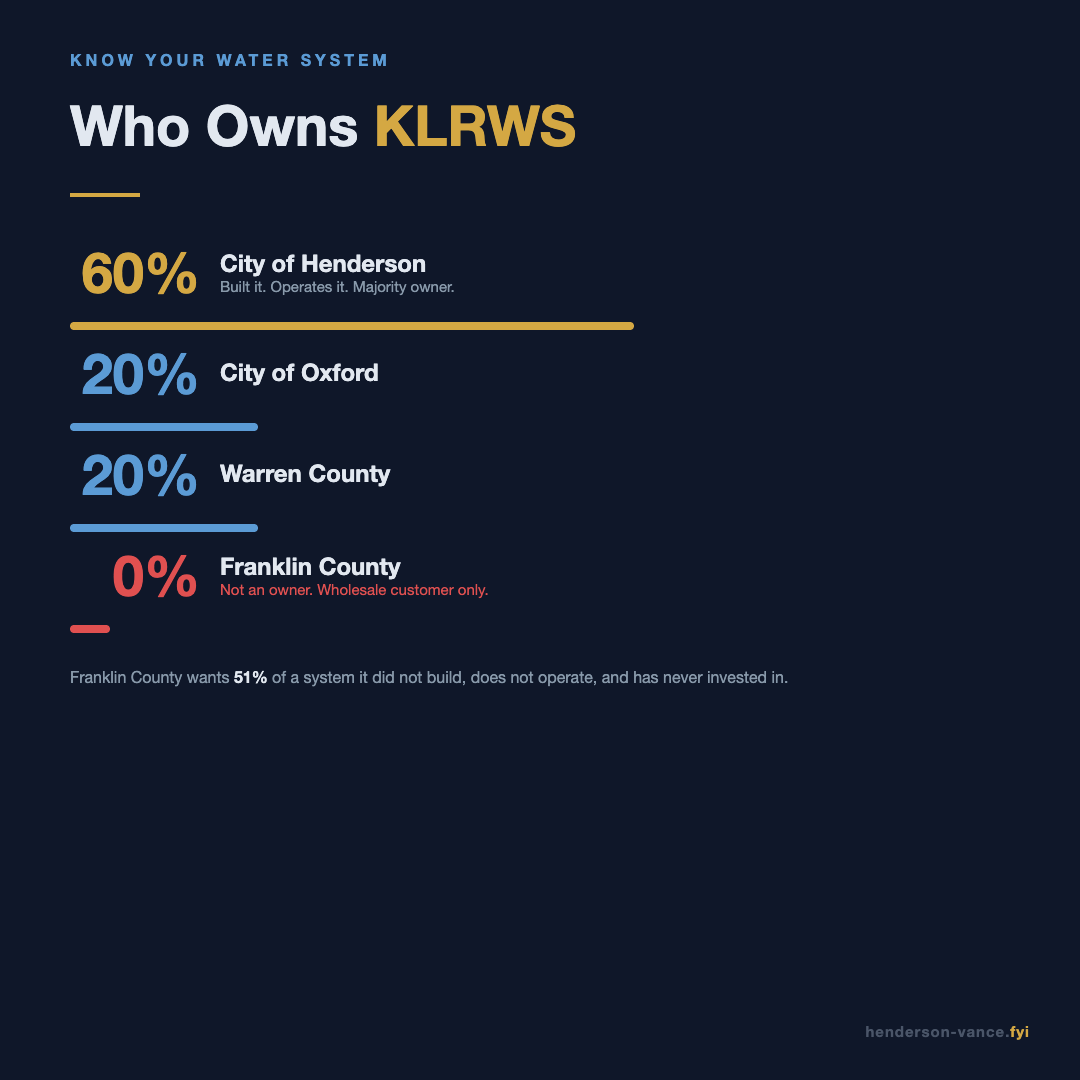
KLRWS Ownership
| Partner | Ownership | Role |
|---|---|---|
| City of Henderson | 60% | Operator and majority owner |
| City of Oxford | 20% | Partner owner |
| Warren County | 20% | Partner owner |
| Franklin County | 0% | Wholesale customer (not an owner) |
Source: City of Henderson KLRWS page, NC DEQ IBT Certification
System Capacity
6.9 MGD
Current daily draw
10 MGD
Current plant rated capacity
20 MGD
Expansion target (under construction, ~$80M)
14.2 MGD
IBT certificate cap (hard regulatory ceiling)
The Interbasin Transfer Ceiling
Kerr Lake sits in the Roanoke River Basin. Most KLRWS customers are in other basins. Moving water across basin lines requires an IBT certificate from the NC Environmental Management Commission. The current certificate caps transfers at 14.2 MGD across three basins:
10.7 MGD
Tar River Basin
1.7 MGD
Fishing Creek Basin
1.8 MGD
Neuse River Basin
Exceeding 14.2 MGD requires a new IBT proceeding, which takes years and includes public comment where any entity can object.
The Pipeline Bottleneck
Even with the plant expanding to 20 MGD, the 24-inch transmission main serving Henderson, Vance County, and Franklin County can only convey 5 MGD. Henderson and Vance County need some of that 5 MGD themselves. This is why Franklin cannot simply buy more water from Henderson. The pipe is the constraint, not the plant.
Source: Letter from Ryan C. Preble, May 21, 2026 (footnote 3); KLRWS Expansion page
Who Gets Water from KLRWS
KLRWS serves over 50,000 customers across portions of four counties through its three owner-partners and their wholesale customers:
City of Henderson
Owner (60%)
City of Oxford
Owner (20%)
Warren County
Owner (20%)
Town of Warrenton
Wholesale
Town of Norlina
Wholesale
Town of Kittrell
Wholesale
Town of Stovall
Wholesale
Town of Middleburg
Wholesale
Vance County
Wholesale
Granville County
Wholesale
Franklin County
Wholesale (not an owner)
Source: City of Henderson KLRWS page, Franklin County Future Water
The $80 Million Expansion
KLRWS is currently expanding from 10 MGD to 20 MGD. Ground was broken in May 2023. CDM Smith is the design-build contractor. The project cost has grown from the original $39.9 million estimate to approximately $80 million due to COVID-era inflation. Funding secured includes $45.9 million in grants and loans plus $15 million in water revenue bonds.
Oxford's 20% share of the expansion was partially funded by a $10 million state appropriation in October 2023. In 2025, House Bill 74 attempted to redirect that $10 million to other districts. Oxford and its partners fought back. The expansion cost is shared 60/20/20 per the ownership structure.
Sources: KLRWS Expansion, WUNC, Henderson Dispatch
The Source
Kerr Lake: The Full Picture
John H. Kerr Reservoir (Kerr Lake) was built by the Army Corps of Engineers between 1947 and 1952 on the Roanoke River at the NC/VA state line. It is managed by the USACE Wilmington District. Water supply is only one of its authorized purposes, alongside flood control, hydropower, recreation, and fish and wildlife.
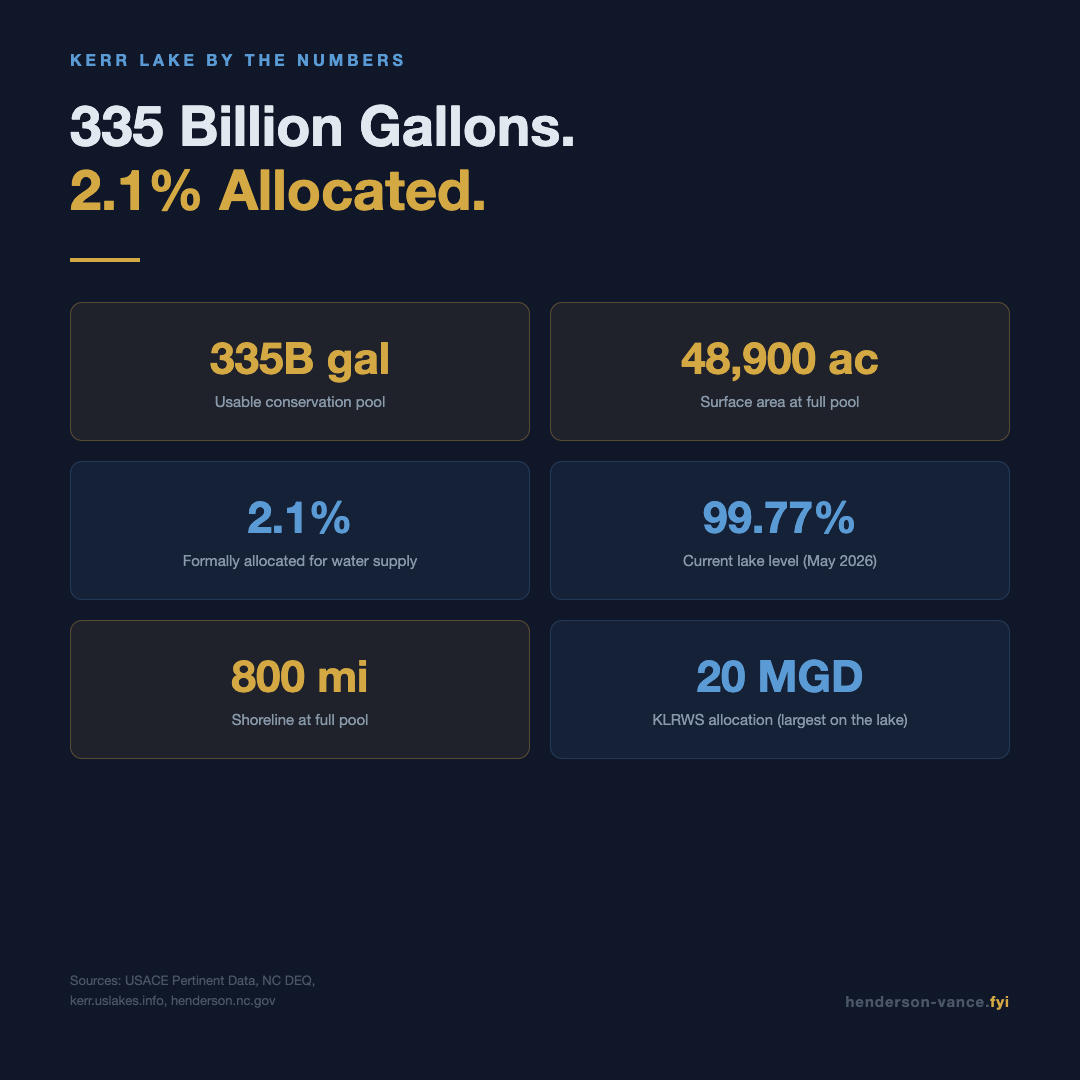
335B
Gallons in usable conservation pool
48,900
Acres at full pool
800 mi
Shoreline
Current Lake Level (May 22, 2026)
299.30 ft MSL - 99.77% of full pool
North Carolina is experiencing its worst drought since the 1930s Dust Bowl. March 2026 was the driest month on record. 61% of the state is under extreme drought. Despite this, Kerr Lake remains near full pool because its large watershed buffers short-term precipitation deficits. But hydrologists warn groundwater recharge is failing, and the lake cannot hold indefinitely.
Everyone Drawing Water from Kerr Lake
Only six entities have formal water storage contracts or grandfathered rights with the Army Corps to withdraw water from Kerr Lake. KLRWS (Henderson) holds the largest allocation.
| Entity | Allocation | % of Pool | Max Withdrawal |
|---|---|---|---|
| KLRWS (Henderson, NC) | 10,292 AF | ~1.0% | 20 MGD |
| City of Virginia Beach | 10,200 AF | 1.066% | Via Lake Gaston pipeline |
| VA Dept. of Corrections | 23 AF | 0.0024% | 0.06 MGD |
| Dominion / Mecklenburg Cogen | 600 AF | 0.063% | ~3 MGD |
| Town of Clarksville, VA | Grandfathered | No limit | ~0.23 MGD avg |
| Burlington Industries | Grandfathered | No limit | Plant closed 2004 |
| Total Allocated | ~21,115 AF | ~2.1% |
Approximately 98% of Kerr Lake's usable conservation pool is not formally allocated for water supply.
That does not mean it is "free." The unallocated portion serves hydropower generation, low-flow augmentation for downstream ecosystems, fish and wildlife habitat, and recreation (1 million+ annual visitors). These are all authorized project purposes that compete with water supply. Any new allocation requires the Army Corps to determine whether water can be reallocated without harming these other purposes.
Source: USACE Kerr Dam Pertinent Data, USACE Reallocation Study
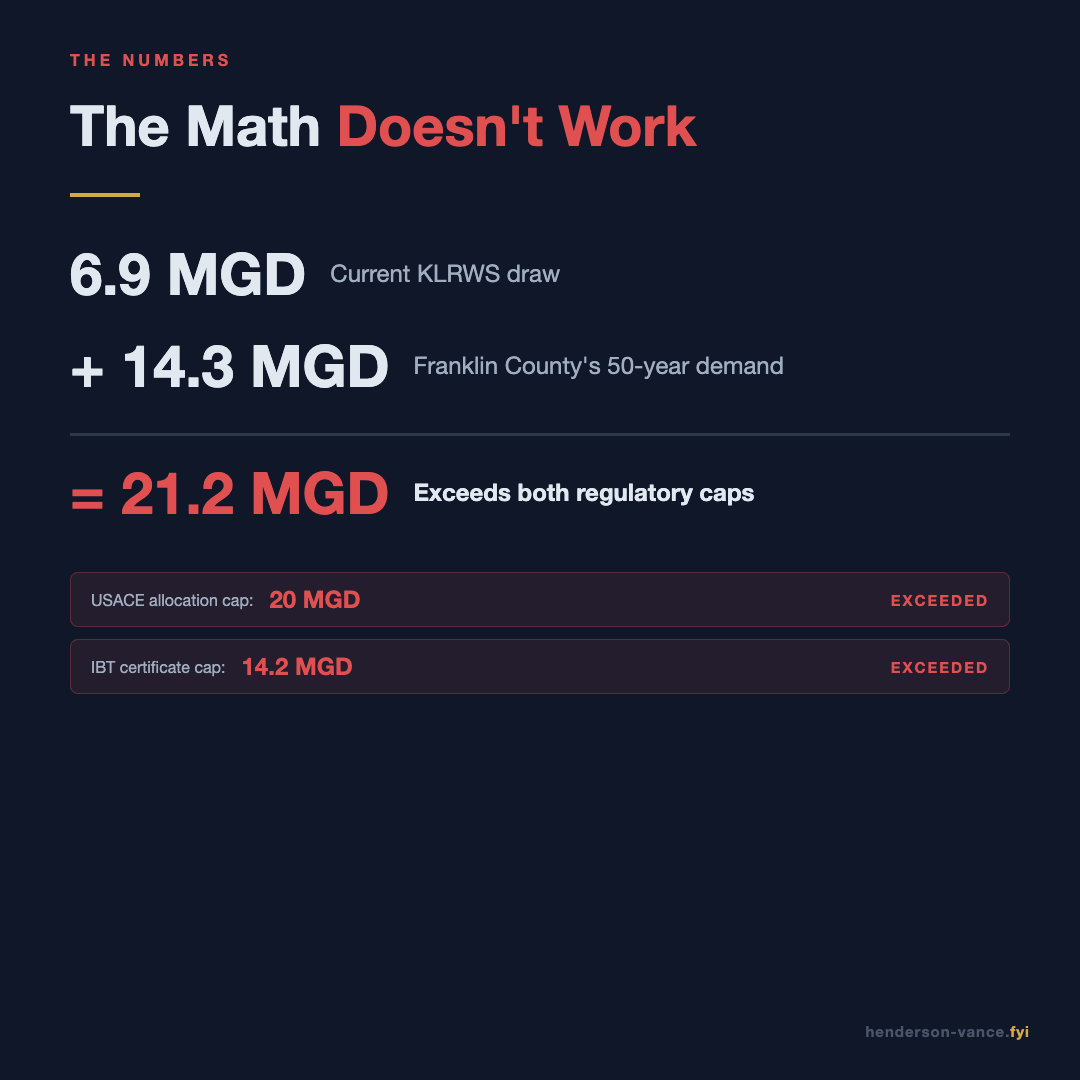
The Math That Doesn't Work
Franklin County wants 14.3 MGD of finished water. KLRWS currently draws 6.9 MGD. Combined, that's 21.2 MGD.
6.9 MGD
Current KLRWS draw
+ 14.3 MGD
Franklin's 50-year demand
= 21.2 MGD
Exceeds both caps
That exceeds both the USACE allocation (20 MGD) and the IBT certificate (14.2 MGD).
Franklin County's full 50-year demand cannot be met under existing regulatory approvals. A new IBT proceeding would take years. A new USACE allocation would require Congressional authorization if it exceeds the original project scope. These are not negotiation points. They are regulatory ceilings.
The Path Forward
What a Fair Deal Could Look Like
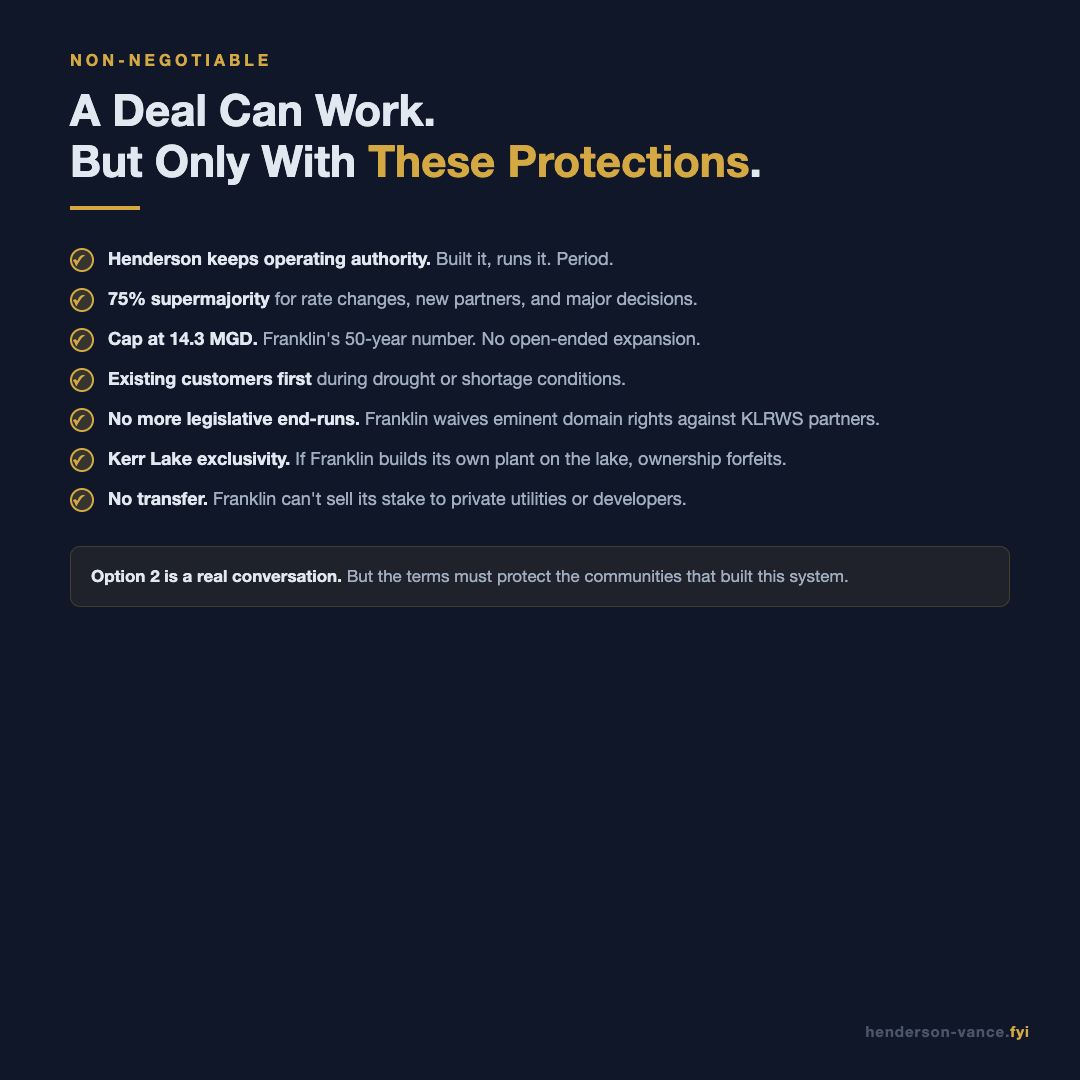
Franklin County's water challenge is real. A 51% ownership stake is not the answer. But Option 2 in the Preble letter - a lower percentage with the right to expand at Franklin's cost - is a conversation worth having. If the terms are right, this could be a deal that works for everyone in the region. But the terms must be right.
Why 51% Cannot Happen
Henderson built and has operated KLRWS for over 50 years. It currently holds 60% ownership. A 51% transfer to Franklin County means Franklin controls the board, controls rate-setting, controls expansion priorities, and controls who else gets water.
Henderson and Vance County depend on this water for their own growth, including potential data center developments that could consume 300,000 to 1 million gallons per day. Handing majority control to a county that is contiguous to Wake County and will grow significantly faster than Vance County is handing them the keys to our water future.
Why Option 2 Can Work - With Protections
Franklin County paying for its own infrastructure while purchasing water through KLRWS is a win-win. Henderson gets revenue. Franklin gets water. The system gets stronger. But the governance terms must protect the communities that built this system.
Ownership proportional to investment, not demand.
Franklin's stake should reflect what they invest into the system, determined by an independent appraisal of total enterprise value. The letter says Franklin wants ownership 'commensurate with its debt.' That's reasonable, but the denominator matters. KLRWS's value includes 50 years of operations, the USACE allocation, the IBT certificate, and institutional relationships, not just hard assets.
Henderson must retain operating authority.
Henderson built it, Henderson runs it. Operational control cannot transfer to a new partner regardless of ownership percentage. This should be written into any agreement as non-negotiable.
Supermajority voting for major decisions.
Rate changes, new partners, asset sales, and capital expenditures above a threshold should require 75% approval. This gives Henderson effective veto power even without majority ownership, and ensures no two partners can override the system's founders.
Expansion rights capped at 14.3 MGD.
Franklin's own 50-year plan defines this number. Cap it. If they need more in the future, they come back to the table. No open-ended expansion rights.
Existing customer priority during drought.
When Kerr Lake levels drop, water curtailment should be proportional to historical investment, not current ownership percentage. Partners who have been in since the 1970s get priority over a partner that joined in 2026.
Non-circumvention clause.
After SB 214 and SB 320, any agreement must include explicit language: Franklin permanently waives the right to pursue legislative action or eminent domain against KLRWS participants. If they go back to the General Assembly while under contract, the agreement terminates.
Kerr Lake exclusivity.
If Franklin secures an independent Army Corps allocation for Kerr Lake and builds its own treatment facility drawing from the lake, their KLRWS ownership automatically forfeits to the existing partners. Henderson is sacrificing its own growth capacity to sell water to Franklin. If Franklin then puts its own straw in the same lake, that's a direct conflict. Different sources (Tar River, Lake Gaston) would not trigger this clause.
Transfer restrictions.
Franklin cannot sell, assign, or transfer its ownership stake to any third party, especially private utilities or developers, without unanimous consent of existing partners.
The Money: What This Deal Is Actually Worth
This is not just a water negotiation. This is a revenue opportunity for Henderson and the KLRWS partners. Franklin County needs water at scale, and they are willing to pay for it. The question is whether Henderson comes to the table with a real offer or continues to say no until the state legislature or the Army Corps forces a worse outcome.
What Franklin Pays Now
The exact wholesale rate Franklin County pays Henderson for KLRWS water is not published in any publicly available document. However, Rep. Matthew Winslow (R-Franklin) stated publicly that Henderson charges Franklin County "four times as much as other customers who receive water from the compact." Henderson Mayor Melissa Elliott disputed the framing but did not challenge the numbers.
If KLRWS partner rates are consistent with NC wholesale benchmarks ($2.50-$4.00/1,000 gallons), a 4x markup would put Franklin County's rate at roughly $10-$16 per 1,000 gallons, approaching or exceeding residential retail pricing. The actual rate is contained in the interlocal agreement between Franklin County and Henderson and should be made public as part of any negotiation.
Source: WRAL, April 26, 2026
What Other NC Systems Charge (Wholesale)
For context, here is what other North Carolina regional water systems charge wholesale customers per 1,000 gallons:
| Seller | Buyer | Rate / 1,000 gal |
|---|---|---|
| Fayetteville PWC | Hoke County | $4.62 |
| Johnston County | Municipal customers | $3.95 |
| Asheville | Wholesale volume | $2.91 |
| Asheville | Capacity-based | $1.64 |
The typical range for NC regional wholesale water is $1.50 to $5.00 per 1,000 gallons. If Franklin County is paying four times the partner rate as Rep. Winslow stated, their current rate is significantly above every benchmark in this table. A fair volume-based rate would bring Franklin closer to these benchmarks while still generating significant revenue for KLRWS.
Sources: UNC EFC NC Water Rates Dashboard, Asheville Rates, Johnston County Fee Schedule
The Revenue Opportunity
Franklin County's 50-year demand is 14.3 MGD. At wholesale rates, even with volume discounts, this represents significant long-term revenue for KLRWS. A volume-based declining block rate structure, standard in NC wholesale agreements, would give Franklin real savings at scale while guaranteeing KLRWS consistent income:
| Volume Tier | Daily Volume | Rate Approach |
|---|---|---|
| Base | 0 - 2 MGD | Standard wholesale rate (match partner rate) |
| Tier 2 | 2 - 5 MGD | 10-15% volume discount |
| Tier 3 | 5 - 10 MGD | 15-25% volume discount |
| Tier 4 | 10+ MGD | 20-30% volume discount |
On top of the per-gallon rate, a fixed monthly capacity charge guarantees KLRWS revenue regardless of how much Franklin actually draws in a given month. This is standard practice in NC wholesale agreements.
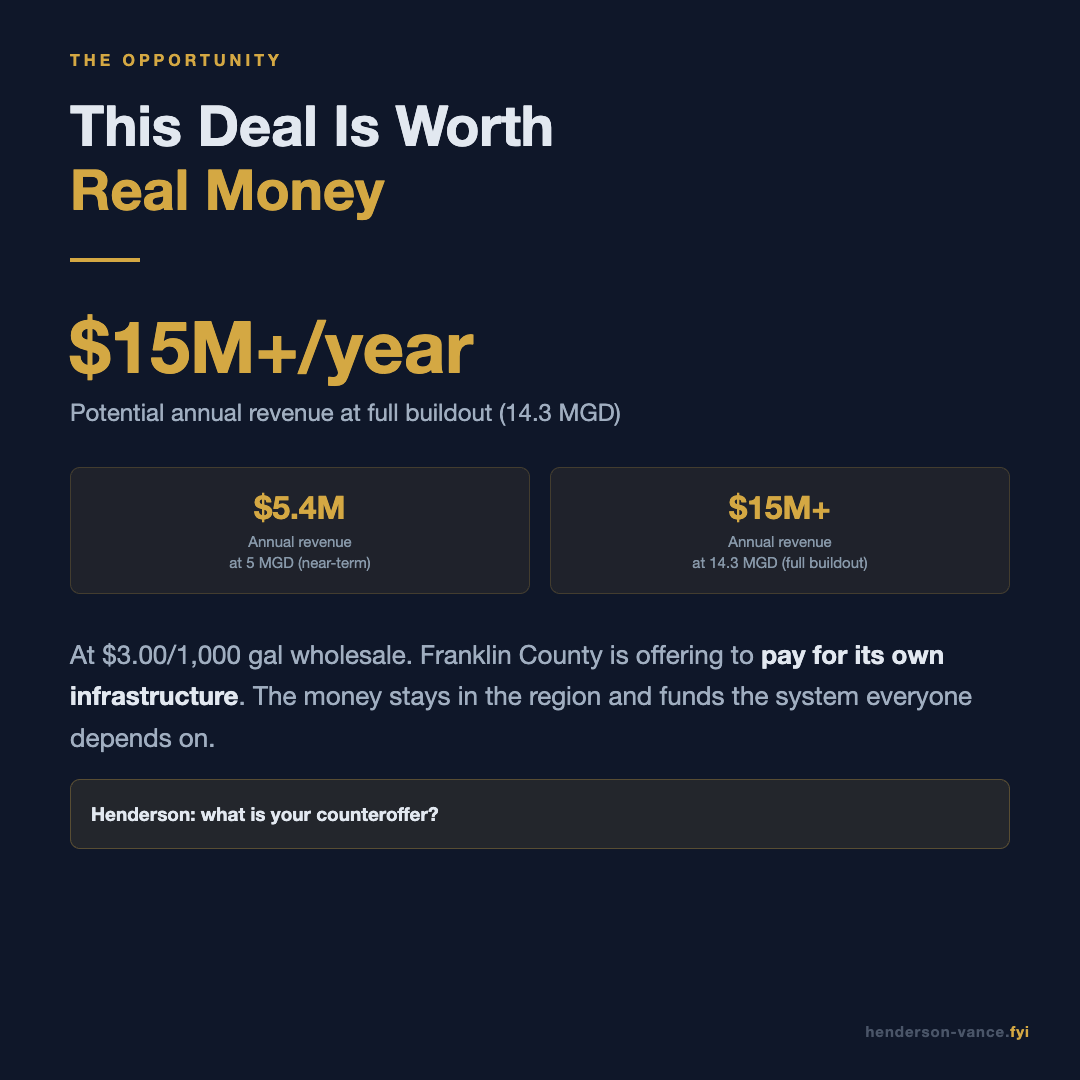
At even a conservative $3.00/1,000 gallons on 5 MGD, that is over $5.4 million per year in revenue for KLRWS. At full buildout (14.3 MGD), the annual revenue potential exceeds $15 million. That money stays in the region and funds the system everyone depends on.
Rate Protections That Must Be in Any Agreement
- Floor rate. Franklin's per-gallon rate can never drop below KLRWS's actual cost of production. The system cannot sell water at a loss.
- CPI escalator. Annual rate increases tied to the Consumer Price Index or actual operating cost increases, whichever is greater. The 0.025% annual escalator Franklin offered in 2021 is not serious. Standard practice is 2-3% per year.
- Most-favored-customer clause. Franklin's effective rate per gallon can never be lower than what Henderson and Vance County residents pay. Bulk discounts for volume are appropriate, but Franklin cannot get a better deal than the communities that built the system.
- Minimum purchase commitment. Franklin commits to purchasing a minimum volume each year, increasing on a ramp-up schedule. This protects KLRWS from investing in capacity that Franklin then chooses not to use.
A Call to Henderson: Come to the Table
Henderson has said no to Franklin County for years. That cannot continue. Every time Henderson refuses to negotiate, Franklin County goes to the General Assembly or the Army Corps, and the outcome gets worse for everyone in the region.
SB 320 in 2019 happened because negotiations stalled. SB 214 Section 5 in 2026 happened because negotiations stalled. This letter happened because negotiations stalled. The pattern is clear: when Henderson does not engage, Franklin escalates.
This deal is worth tens of millions of dollars in long-term revenue for KLRWS. Franklin County is offering to pay for its own infrastructure. The money is real. The demand is real. The alternative to a negotiated deal is a forced outcome that benefits no one in this region.
Henderson controls 60% of KLRWS. That comes with the responsibility to lead, not just to hold. Citizens of Henderson and Vance County should be asking their elected officials and city management: what is our counteroffer? Because right now, the only proposals on the table are coming from Franklin County.
What Henderson Gives Up
This is not Henderson selling surplus water. This is Henderson selling its own future and its own stake in the system it built.
Growth capacity. KLRWS is expanding to 20 MGD. The gap between the current 6.9 MGD draw and 20 MGD is what Henderson and Vance County need for their own growth. Potential data centers. Population increases. Economic development. Every gallon allocated to Franklin is a gallon Henderson cannot use.
Ownership and control. Any ownership stake given to Franklin comes directly out of Henderson's 60%. Henderson is not just selling water. It is permanently reducing its own share of control over the system it built, funded, and operated for over 50 years. That percentage does not come back.
And here is the real risk. Franklin County is simultaneously pursuing a $2 million Army Corps reallocation study to secure its own independent 15.7 MGD allocation directly from Kerr Lake. If that study succeeds and Franklin builds its own treatment plant on the lake, Henderson will have permanently given up ownership percentage and governance control for nothing. Franklin would have its own water source AND a stake in Henderson's system. Henderson would have less control, less capacity, and no ongoing revenue to show for it.
That is why the Kerr Lake exclusivity clause is non-negotiable. If Franklin puts its own straw in Kerr Lake, their KLRWS ownership forfeits. Henderson cannot sacrifice both water and control and get nothing in return.
The door is open. It should stay open.
Franklin County has a legitimate need. Henderson has a system worth investing in. The answer is not a 51% takeover. The answer is not a battering ram through the General Assembly. The answer is neighbors sitting down at the same table with clear terms, fair pricing, governance protections, and a commitment to the region. That has always been the answer.
Timeline of Key Events
2005
Army Corps grants KLRWS 20 MGD allocation from Kerr Lake.
2017
Franklin County adopts Water Allocation Ordinance, restricting new connections.
2019
SB 320 passes Senate 20-17, would withhold $18M in KLRWS funding. Governor Cooper vetoes it.
2020-2024
Franklin County makes repeated requests to Henderson for more water. Henderson declines.
Feb. 2025
Engineering study estimates $78.9M pipeline cost from Vance to Franklin County.
March 2025
SB 214 filed. Original text: deannexations only. No mention of Franklin County.
June 2025
Franklin County submits Letter of Intent to Army Corps for Kerr Lake reallocation.
Aug. 2025
Franklin County signs $2M agreement with Army Corps for reallocation study.
Oct. 2025
Franklin County issues $200M RFQ for private water plant and pipeline.
March 2026
Army Corps holds public scoping meeting at Warren County Armory. 300+ attend. Tremendous opposition.
April 7
Granville County sends formal opposition letter. Citizens group meets at Warren County Middle School.
April 15
Warrenton Board unanimously approves opposition resolution. Haliwa-Saponi Tribal Council adopts opposition resolution.
April 21
Conference committee inserts Part V into SB 214. No public hearing.
April 22
Senate passes SB 214 conference report 28-21. Barnes (Vance County) votes Yes. Sen. Sanderson (R) is the only Republican to vote No.
April 22
House Speaker Destin Hall pulls SB 214 from the House calendar after floor opposition from Rep. Cohn and Rep. Pierce. Bill rescheduled to April 28.
April 24
Army Corps public comment deadline. Vance County, Warren County, City of Henderson, and Roanoke Rapids Sanitary District hold emergency meetings and adopt resolutions opposing SB 214 Part V.
April 24
The Herald reports Franklin County Commission Chairwoman Roxanne Bragg was unaware the provision bypassed county commissioners' consent.
April 26
WRAL and the NC Tribune publish major reports on SB 214. Statewide attention grows.
April 28
Roughly 100 citizens from Halifax, Vance, and Warren Counties travel to Raleigh by bus. Rep. Pierce holds press conference at the Legislative Building with 10 speakers including mayors, county chairs, tribal leaders, and attorneys. SB 214 pulled from House calendar.
April 28
House Speaker Destin Hall announces Section 5 will not appear in the revised conference report. Senate leaders agree to remove it. Franklin County also admitted neighbors were not notified in advance.
April 29
Both chambers vote on revised SB 214 conference report without Section 5 or Section 7 (Forsyth school board provision). Section 5 is officially dead.
April 29
Governor Stein's Rural Listening Session at VGCC, Henderson. 3:30 PM.
May 21
Franklin County Manager Ryan Preble sends formal letter to Henderson, Oxford, and Warren County demanding 51% KLRWS stake or expansion rights. Letter CC'd to General Assembly, Granville County, SGWASA, attorneys, and media (WRAL, Henderson Dispatch, Warren Dispatch, Franklin Times). 30-day deadline: June 21, 2026.
June 3
City of Henderson responds. City Manager Paylor Spruill states Henderson will not enter into an agreement 'until we know we can satisfy our own obligations.' Asks Franklin County to direct future communications to KLRWS partners, not media.
June 21
Franklin County's 30-day deadline passes. No agreement reached. No public breakdown or follow-up reported.
Sept. 2
Franklin County government publishes a post about a public meeting on water infrastructure and 30-50 year plans. The post is later removed with no replacement notice or follow-up.
Sept. 9
Natelli Holdings files a 900 MW multi-phase data center campus plan on 528 acres off US-158. At hybrid cooling, the campus would consume 3.6 to 6.2 million gallons per day from the same KLRWS system.
Sept. 14
Vance County Board of Commissioners holds public hearings on a 60-day data center moratorium, UDO text amendment, and a new rezoning application.
What Comes Next
Section 5 is gone. But the underlying water dispute is accelerating. On May 21, 2026, Franklin County sent a formal letter demanding either a 51% KLRWS stake or expansion rights, with a June 21, 2026 deadline. The letter was CC'd to the General Assembly and media. Here is what to watch and what you can still do.
What Happened
April 28: Roughly 100 citizens from Halifax, Vance, and Warren Counties traveled to Raleigh by bus. Rep. Pierce held a press conference with 10 speakers. The bill was pulled from the House calendar.
April 28 (evening): Speaker Hall announced Section 5 would not appear in the revised conference report. Senate leaders agreed to remove it. Section 7 (Forsyth County school board) was also removed.
April 29: Both chambers voted on the revised SB 214 without Section 5 or Section 7. The eminent domain provision is officially dead.
Key detail: Franklin County admitted neighboring jurisdictions "were not notified in advance" of the provision.
Why "Remain Vigilant"
- May 21, 2026: Franklin County Manager Ryan Preble sent a formal letter demanding 51% KLRWS stake or expansion rights. Deadline: June 21, 2026. CC'd to GA members and media.
- Speaker Hall indicated the legislature could resurrect the provision if local negotiations fail. The Preble letter creates public pressure for a response.
- The Army Corps reallocation study continues. Franklin is funding the entire $2M study. Draft report expected September 2027, final report May 2028.
- Franklin County's $200M RFQ for a private water plant and pipeline is still active.
- The pattern escalates: SB 320 (2019, vetoed), SB 214 Section 5 (2026, removed), Preble letter (2026, pending). Each attempt is more aggressive and more public.
- Franklin's full 50-year demand (14.3 MGD) exceeds both the USACE allocation (20 MGD combined) and the IBT certificate (14.2 MGD). The regulatory math does not support their ask at full scale.
Where Things Stand Now
June 21 deadline: Passed without agreement. No public breakdown or follow-up was reported.
Army Corps NEPA study: Ongoing. The draft Environmental Impact Statement is expected fall 2027. A final decision is possible in 2028. The study is funded entirely by Franklin County.
September 9, 2026 -Natelli filing: Natelli Holdings filed a 900 MW multi-phase data center campus plan on 528 acres off US-158. At hybrid cooling, the campus would draw an estimated 3.6–6.2 million gallons per day from the same KLRWS system -on top of KLRWS's current 6.9 MGD draw and Franklin County's requested 15.7 MGD. No federal entity is currently modeling cumulative demand from data centers and Franklin County simultaneously. See the full water analysis →
State Water Infrastructure Authority: The Authority meets September 16, 2026 in Raleigh. Franklin County's infrastructure needs may surface there.
Sources: Henderson Dispatch, June 6, 2026; WIZS; Vance County Planning Dept., September 9, 2026; NC DEQ press release, September 8, 2026.
What You Can Still Do
1. Thank the leaders who stood up. Hold others accountable.
| Name | District | Phone |
|---|---|---|
| Rep. Bryan Cohn (D) | District 32 (Granville + Vance) | (919) 733-5824 |
| Rep. Matthew Winslow (R) | District 7 (Franklin + part of Vance) | (919) 715-3032 |
| Rep. Rodney Pierce (D) | District 27 (Halifax, Northampton, Warren) | (919) 733-5662 |
| Sen. Lisa Barnes (R) | District 11 (Franklin, Nash, Vance) | (919) 715-3030 |
| Sen. Norman Sanderson (R) | District 2 (Halifax, Warren + others) | (919) 733-5706 |
2. Submit comments to the Army Corps (study is ongoing).
The Army Corps reallocation study is separate from SB 214 and will continue regardless. Written public comments are part of the official federal record. The formal comment deadline was April 24, 2026, but late comments may still be considered.
Email: CESAW-JHKerr-Reallocation-Franklin@usace.army.mil
USACE project page: saw.usace.army.mil/Locations/District-Lakes-and-Dams/John-H-Kerr-1/JHK-Reallocation-Franklin-County/
3. Stay connected and share this page.
Forward this page to your neighbors, your commissioners, your church, your civic organizations. The more people who understand what happened and what could come next, the harder it is to try again quietly.
4. Demand good-faith regional negotiations.
The best way to prevent another Section 5 is for Henderson, Vance County, and the KLRWS partners to proactively engage Franklin County in a regional water solution. And for Franklin County to come to the table as a partner, not with a battering ram.
Get Involved
We are forming a coalition of citizens from Vance, Warren, Halifax, and Granville Counties who believe water policy should be decided through good-faith partnerships, not legislative overreach.
What We Stand For
- Local control. County commissioners should have a voice when another county wants to acquire land within their borders. That is existing law. SB 214 Part V overrides it.
- Regional partnership. Franklin County needs water. The answer is investing in the Kerr Lake Regional Water System together, not building a competing system that undermines the existing one.
- Transparency. Part V was inserted with no public hearing, no committee review, and no notice to affected counties. Citizens deserve to know what is being decided in their name.
- Fairness on all sides. We call on Henderson and Vance County to come to the table with Franklin County in good faith. If they have been asking for four years, our leaders owe them a serious conversation.
What We Are Doing
- Organizing residents to attend the Governor's Rural Listening Session at VGCC on April 29 (3:30 PM).
- Coordinating calls to House members before the vote on SB 214.
- Planning a respectful, silent presence at the NC General Assembly when SB 214 reaches the House floor.
- Building a contact list of citizens willing to attend public meetings and commissioner sessions.
- Sharing sourced, factual information so every resident can form their own informed opinion.
This is not about being against Franklin County. It is about making sure decisions that affect our land, our water, and our communities are made through dialogue, not through 4 lines inserted into a bill at the last minute. If you believe neighbors should work together instead of going around each other, we want to hear from you.
Sign Up
Share These Cards
Franklin County letter, KLRWS ownership, Kerr Lake numbers, and what a fair deal looks like. 10 cards, every fact sourced.
Save and share on social media. Click any card to view full size.
Share These Cards
Save and share on social media. Click any card to view full size.


Download the Reports
New - May 2026
The Kerr Lake Water Question
Franklin County letter analysis, KLRWS ownership, Kerr Lake allocations, rate benchmarks, revenue projections, and governance protections. Every claim sourced.
April 2026
SB 214 Fact Sheet
9 pages on the eminent domain provision, the coalition that stopped it, and what comes next. Printable.