September 9, 2026
Natelli has filed a 900 MW campus plan. Their redline proposes 65 dBA noise limit at property lines and weakens fence requirements.
New - April 2026
The Noise Question
What does a data center actually sound like? Before Vance County votes, here are the numbers.
Sourced from peer-reviewed research, government noise standards, and firsthand accounts from communities living next to data centers.
Share These
Noise & Infrasound Cards
20 visual cards covering audible noise, distance decay, infrasound, and what good regulation looks like. Save and share on social media, print them out, or text them to your neighbors.

The Science
Audible Noise
Decibel Scale
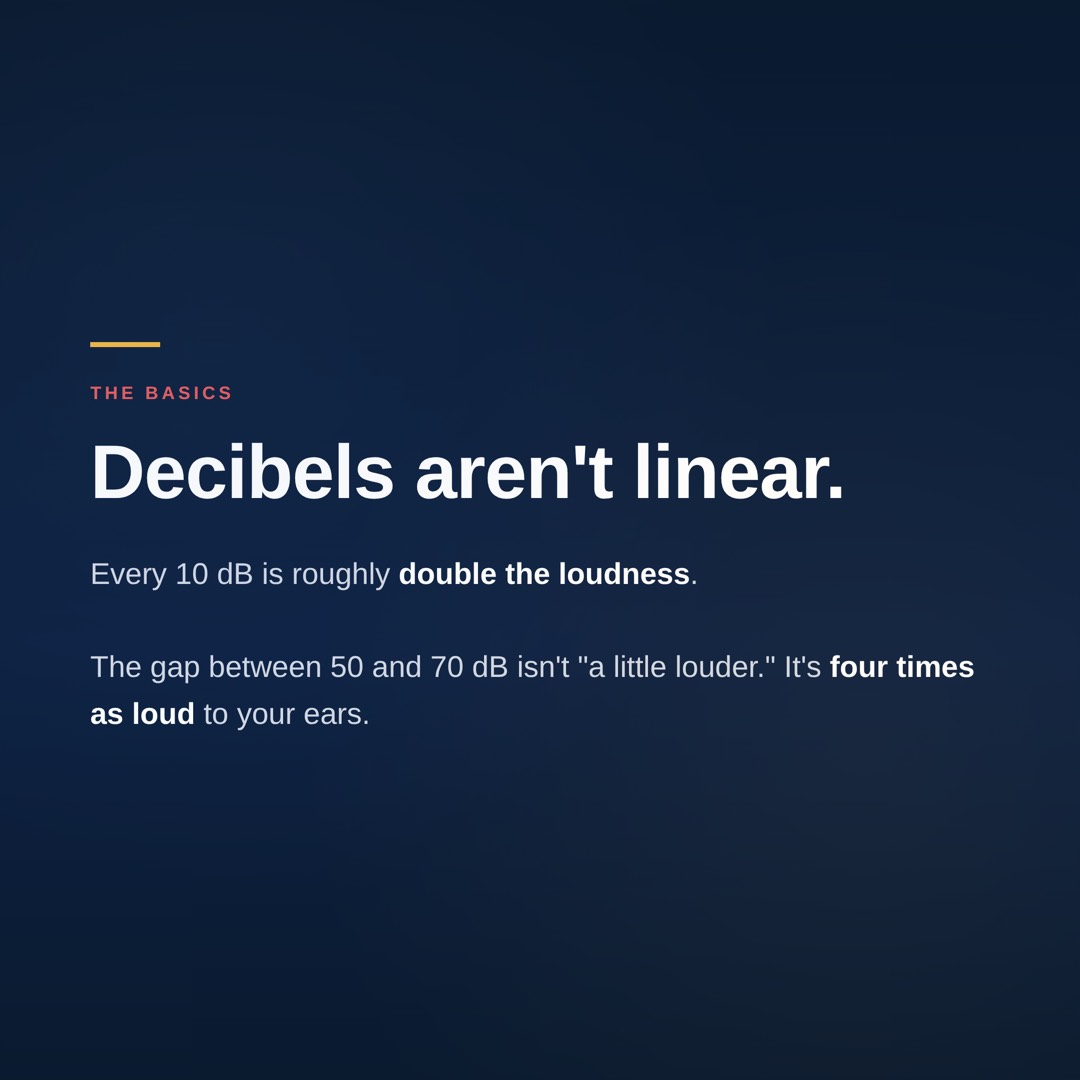
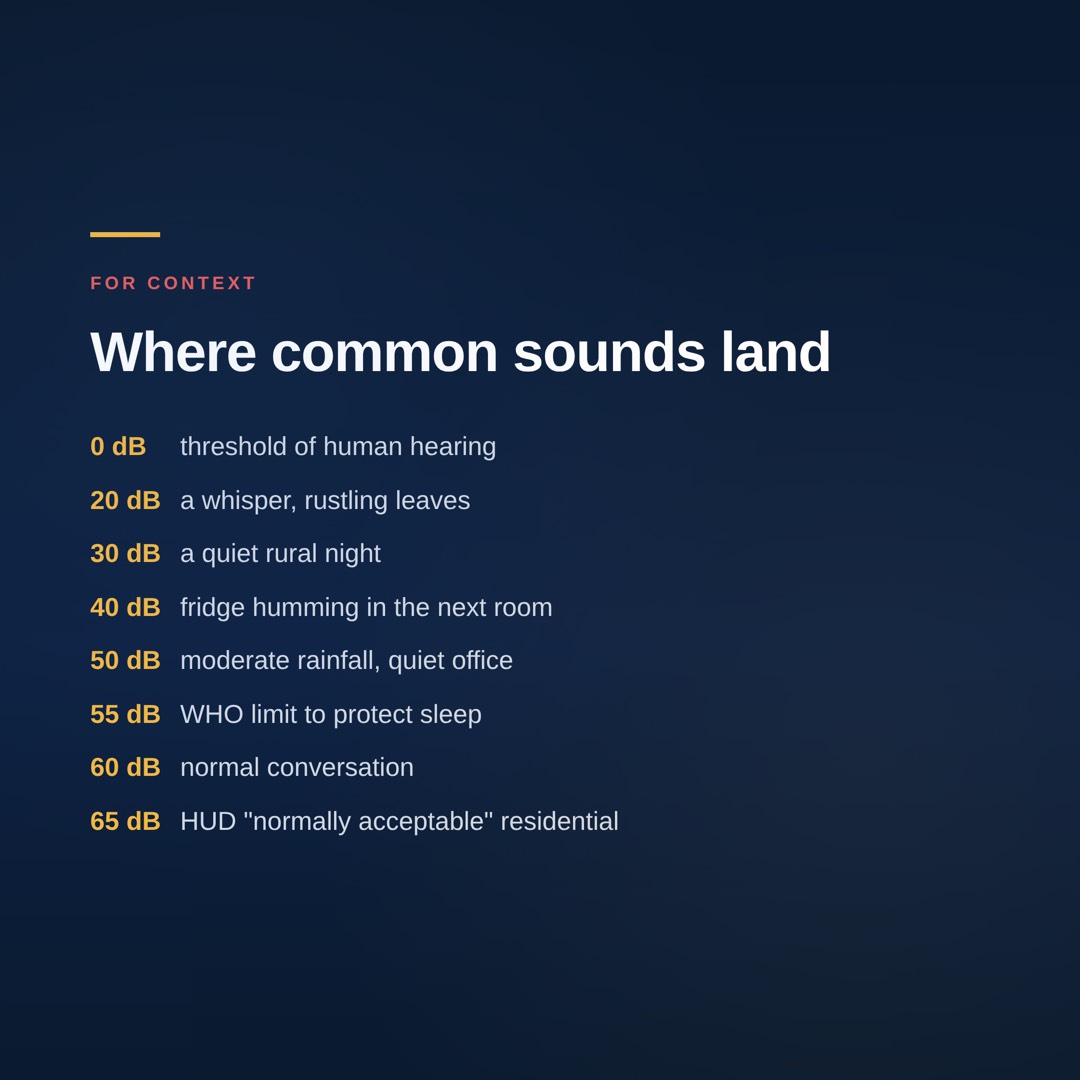
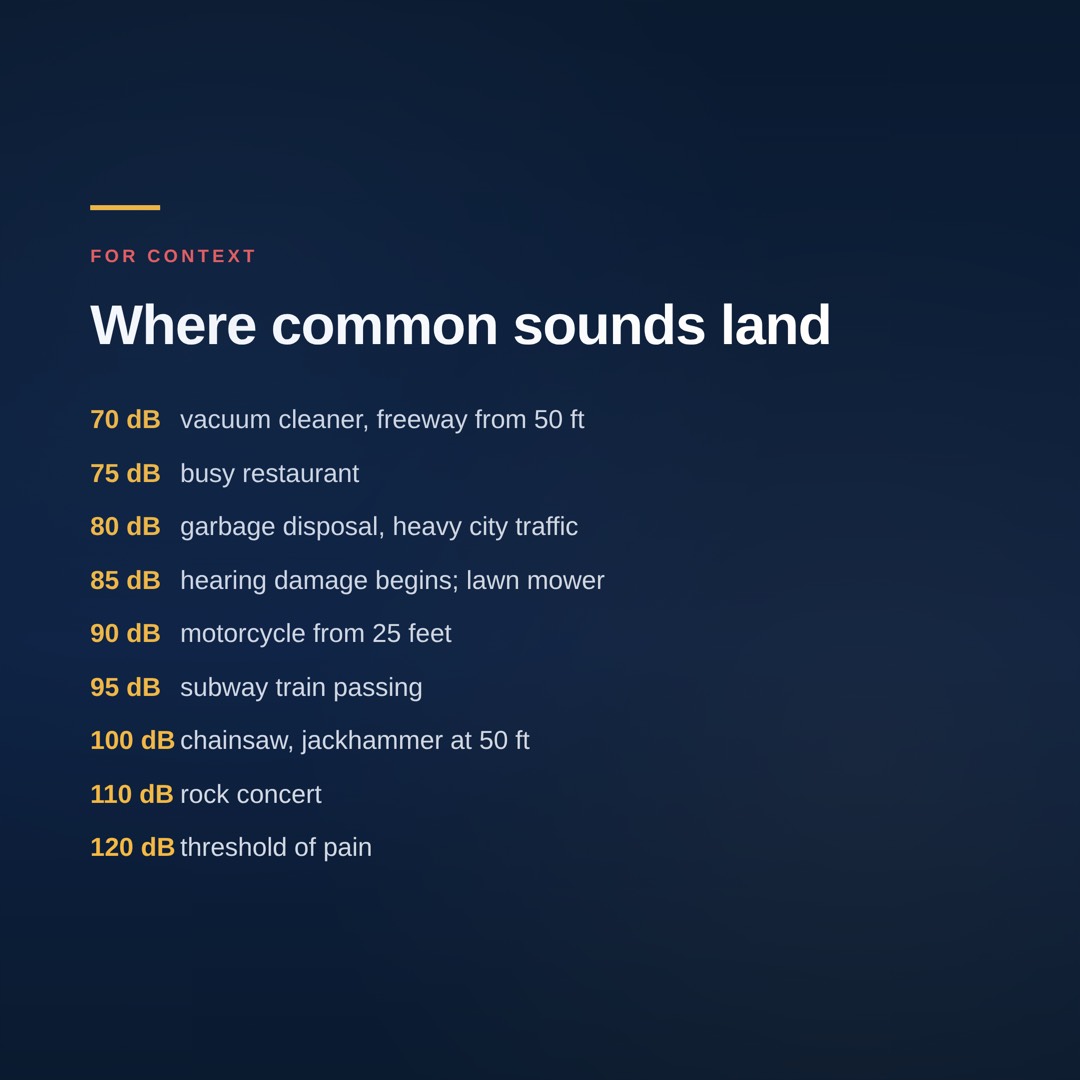
Decibels are logarithmic, not linear. Every 10 dB increase doubles perceived loudness. A 70 dB source sounds twice as loud as 60 dB, and four times as loud as 50 dB. This means the difference between a well-buffered and poorly-buffered facility is not incremental; it is a multiple.
Source: NIOSH Occupational Noise Exposure criteria; WHO Environmental Noise Guidelines for the European Region (2018)
Well-Designed vs. Poorly Buffered
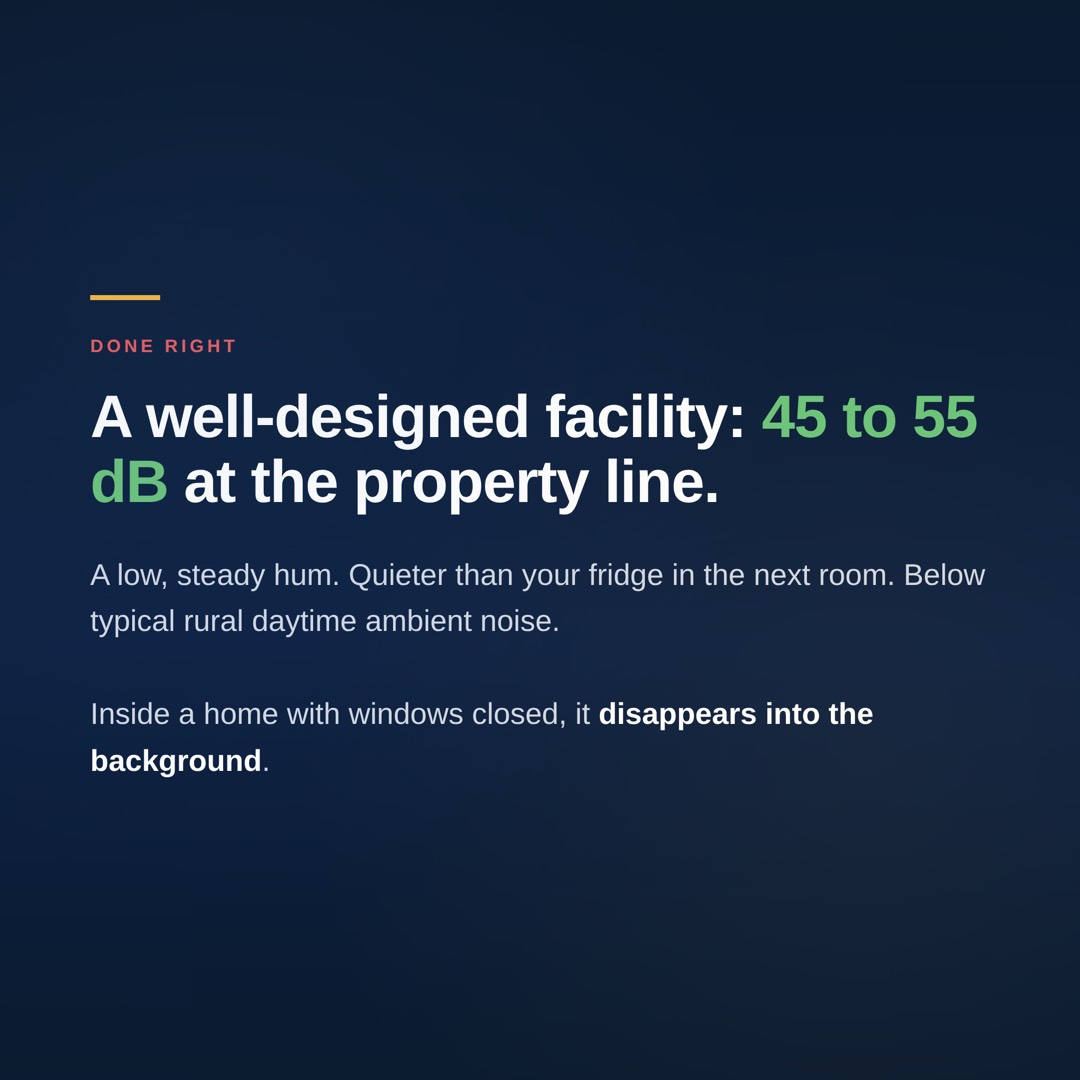
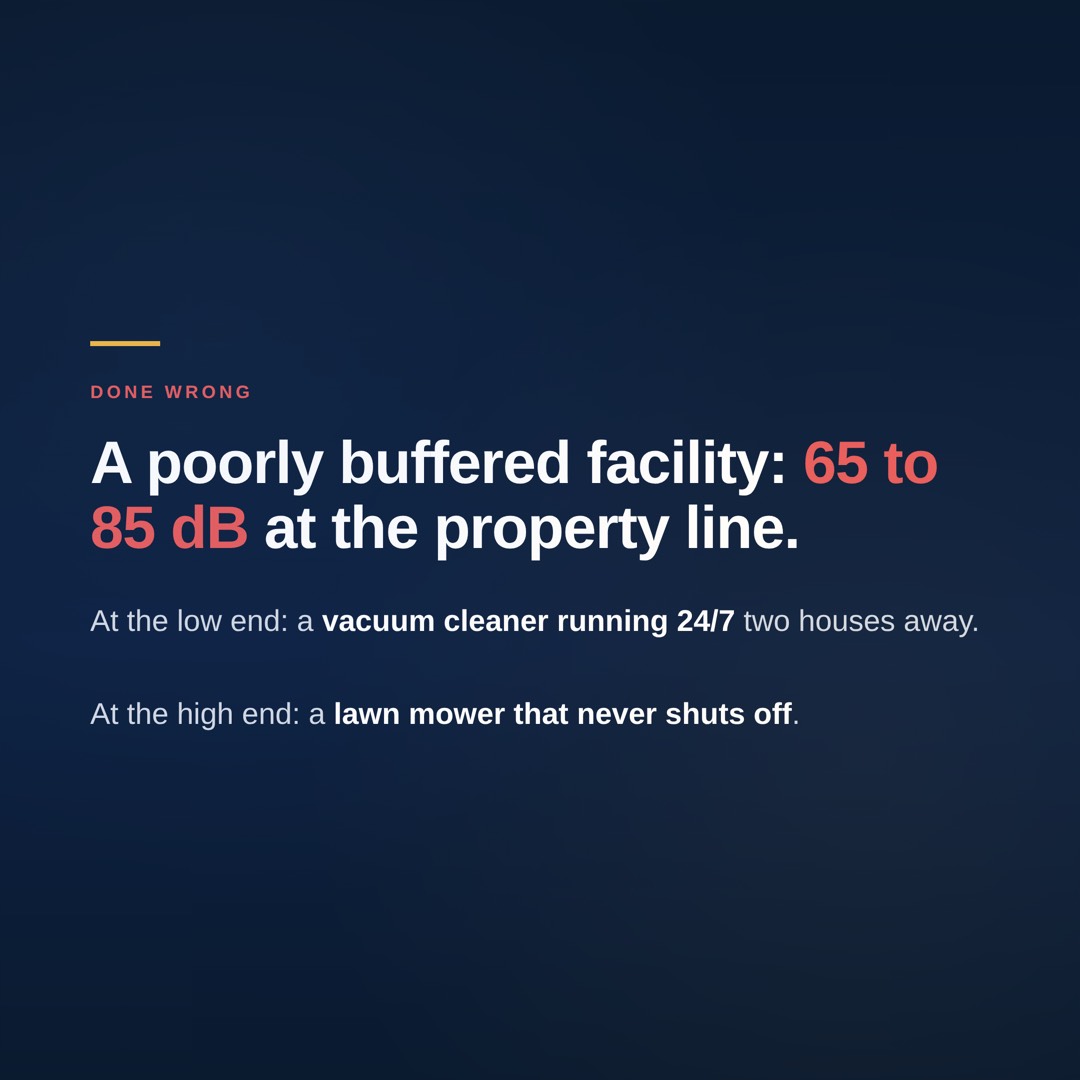
A well-designed data center with proper sound barriers, mechanical enclosures, and setbacks measures 45-55 dB at the property line (comparable to moderate rainfall or a quiet office). A poorly-buffered facility can reach 65-85 dB at the property line (equivalent to a vacuum cleaner to a food blender running 24/7/365).
Sources: Salford University acoustic study of UK data centers (2023); Virginia noise complaints documented by Prince William County and Loudoun County residents
What Good Buffering Requires
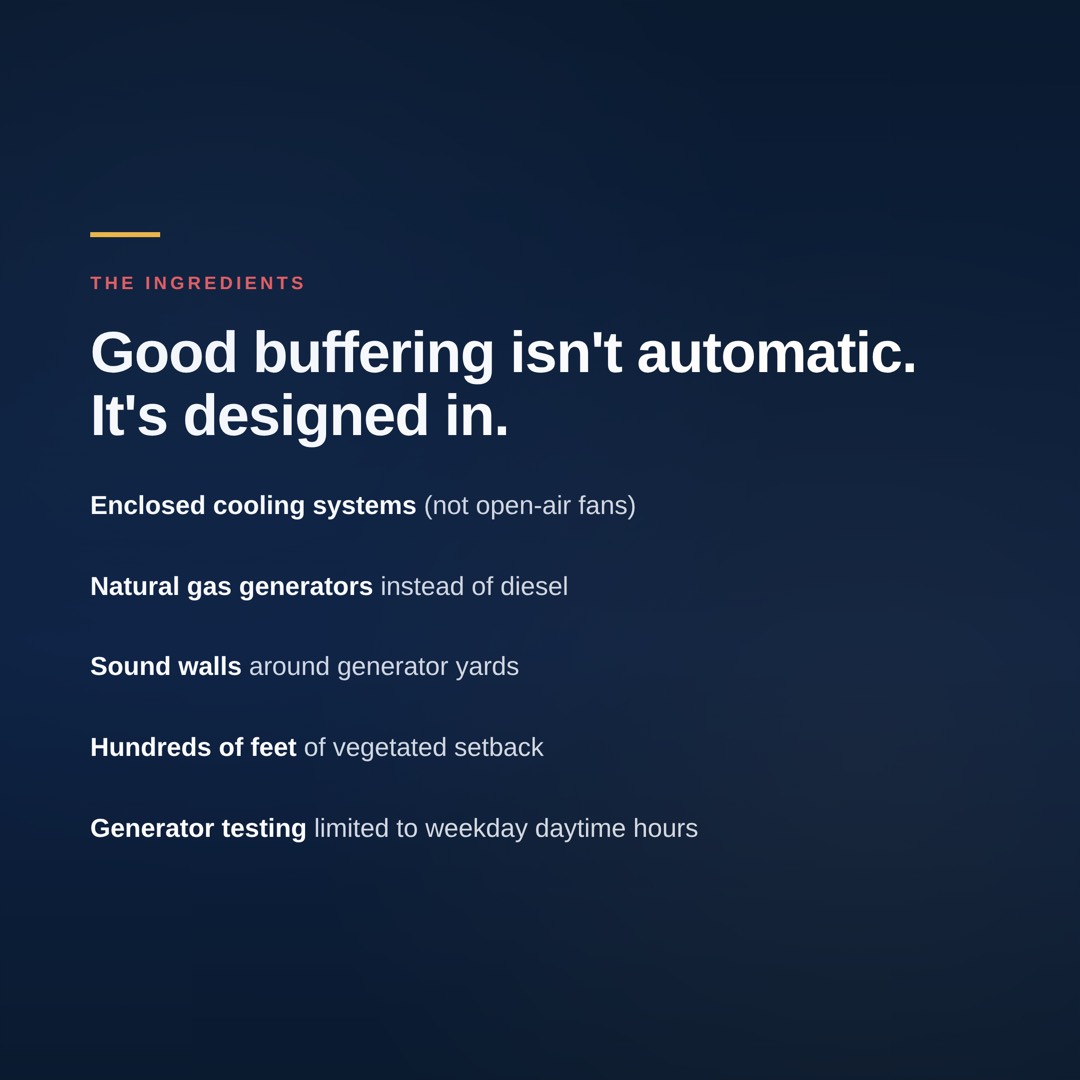
- Sound-rated mechanical enclosures on all HVAC and cooling units
- Solid concrete or masonry sound barrier walls (not chain-link or landscaping)
- Minimum setbacks of 500-1,000 feet from residential property lines
- Low-noise fan selections and variable-speed drives
- Ongoing monitoring with enforceable limits and penalties
Sources: ASHRAE data center design guidelines; Loudoun County VA Zoning Ordinance noise provisions; Lea County NM data center ordinance (2024)
Distance Decay
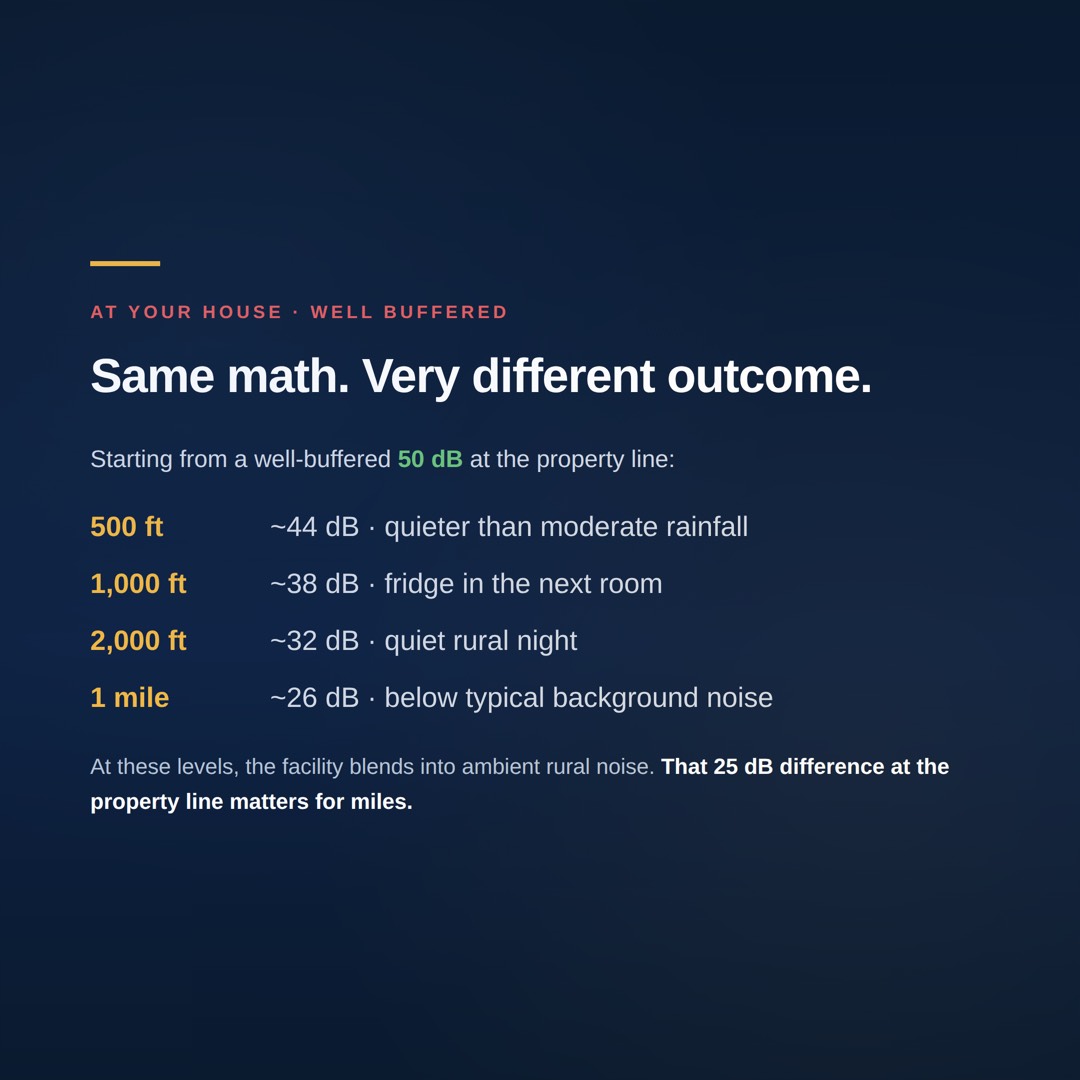
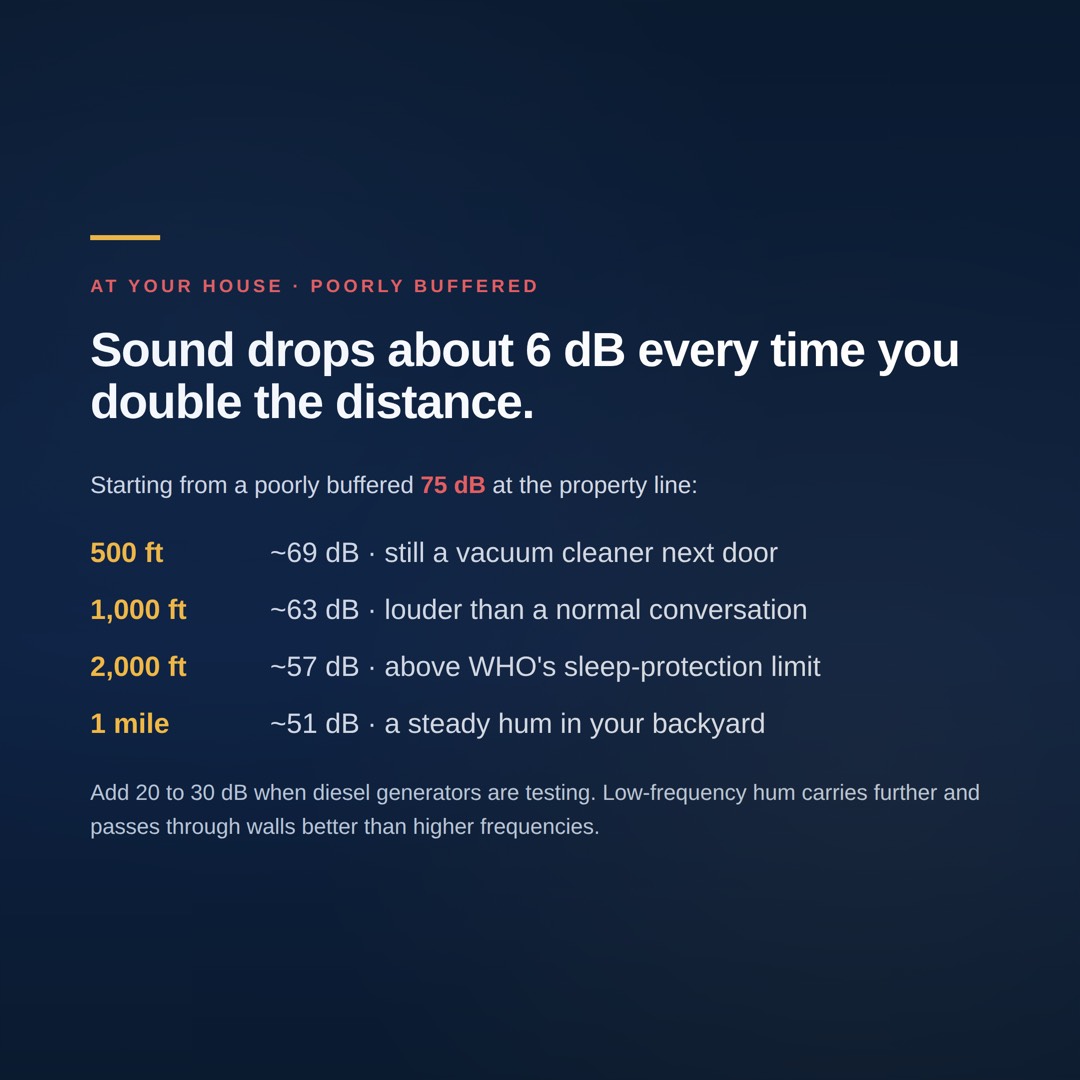
Sound decreases by approximately 6 dB per doubling of distance from a point source in open terrain (inverse square law). A well-buffered facility at 50 dB drops to ~38 dB at 1,000 feet. A poorly-buffered facility at 75 dB is still ~57 dB at 1,000 feet and ~45 dB at one mile - clearly audible at night when ambient noise drops to 30-35 dB.
Source: Inverse square law (standard acoustics); EPA Levels Document (1974); WHO Night Noise Guidelines (2009)recommend <40 dB outside bedrooms
From the Front Lines
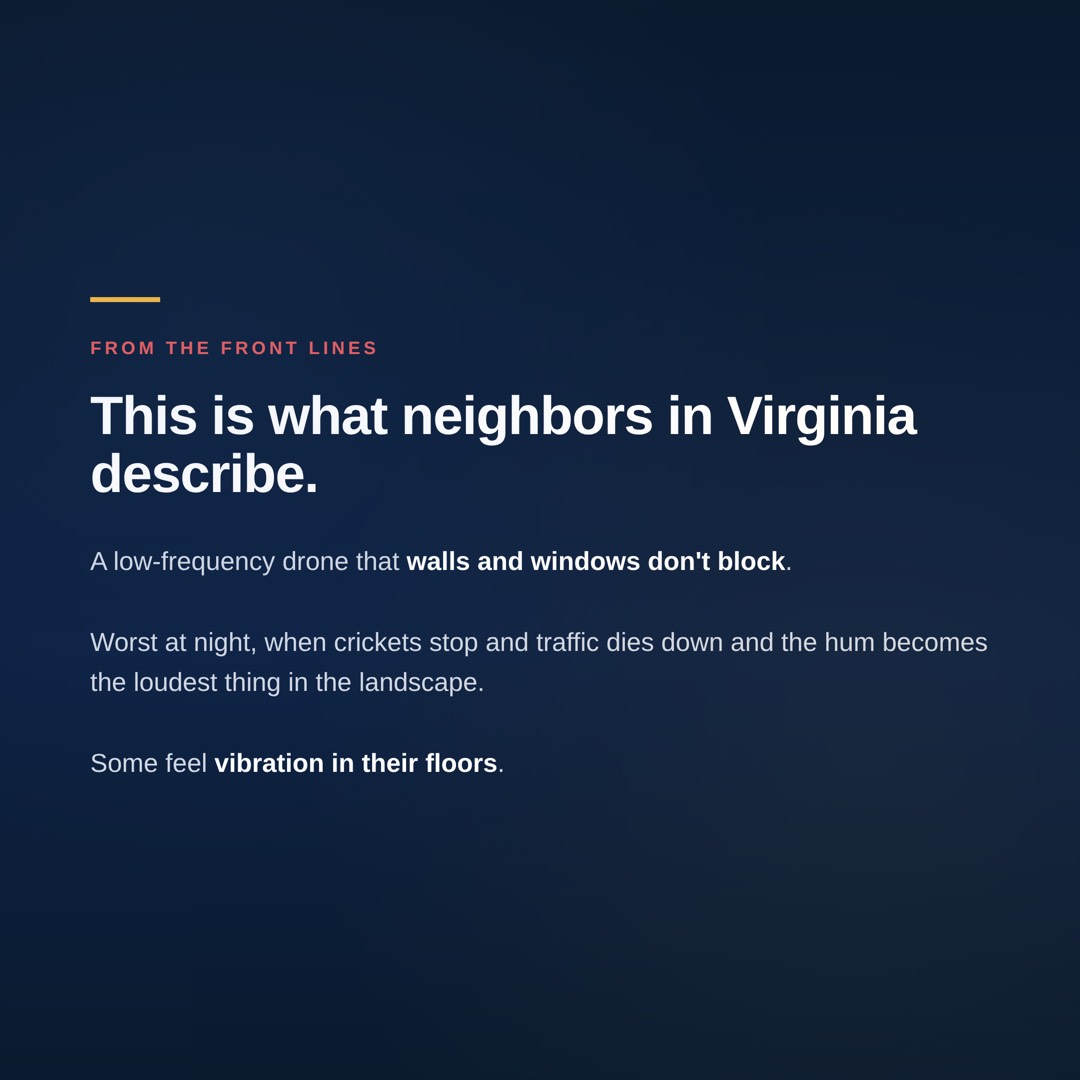
Residents near data centers in Loudoun County and Prince William County, Virginia report constant low-frequency drone audible inside their homes with windows closed. Virginia has no statewide noise ordinance for data centers. Multiple communities have filed complaints about 24/7 operational noise from cooling systems and backup generators. Prince William County residents near the QTS data center campus documented noise levels exceeding county limits.
Sources: Prince William County Board of Supervisors noise complaints (2022-2024); Loudoun County resident testimony at planning commission hearings; WJLA/ABC7 investigative reporting on Northern Virginia data center noise (2023)
Diesel Generator Testing
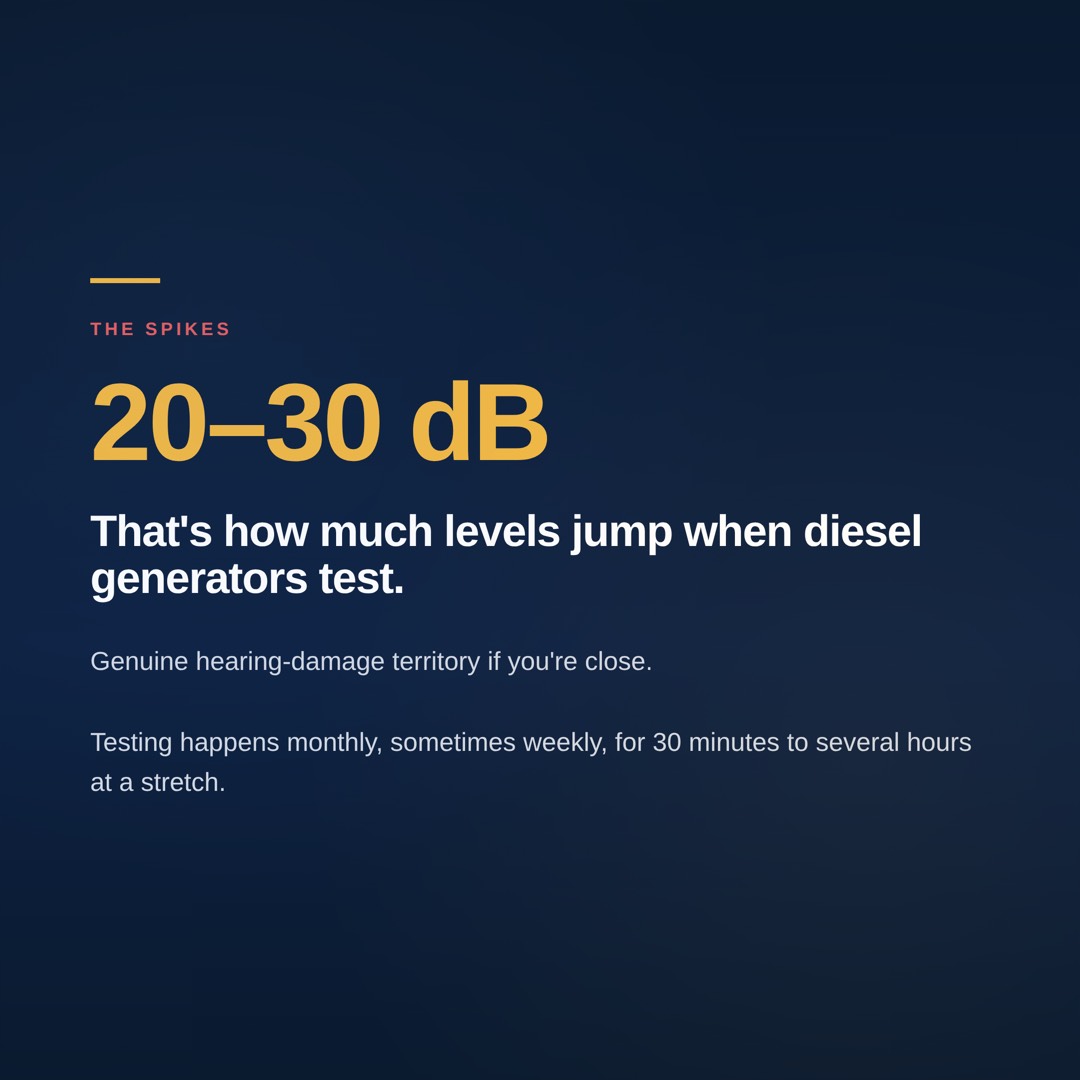
Data centers test backup diesel generators regularly, typically monthly. These tests produce an additional 20-30 dB above baseline operational noise. A facility running at 55 dB baseline spikes to 75-85 dB during testing, equivalent to standing beside a busy highway. Generator tests can last 30 minutes to several hours. Some facilities run full-load transfer tests quarterly that last even longer.
Sources: Uptime Institute generator testing best practices; EPA AP-42 emission factors for stationary diesel engines; Caterpillar and Cummins generator specification sheets (typical 95-105 dB at 23 feet for 2 MW units)
Below 20 Hz
Infrasound
What It Is
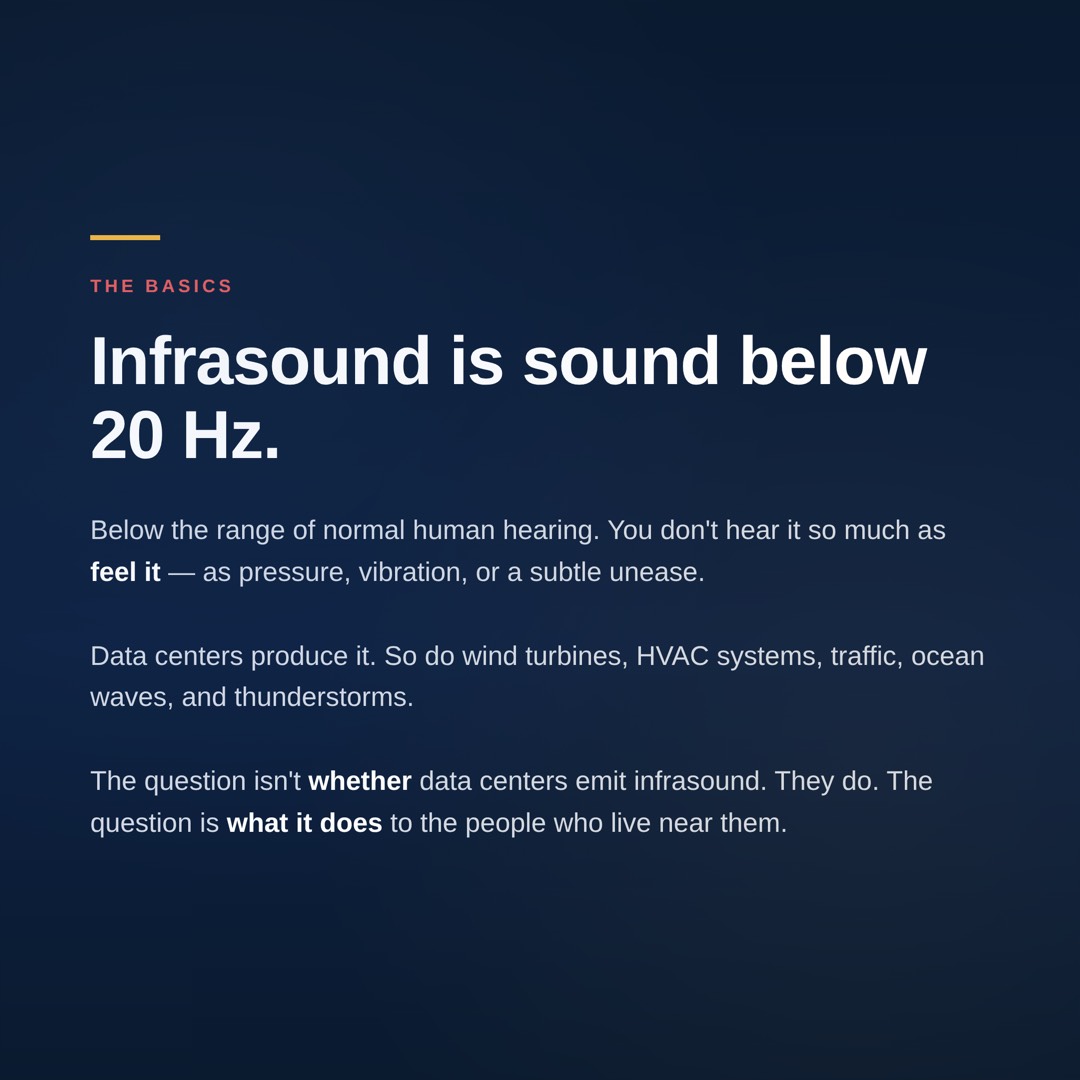
Infrasound is sound below 20 Hz, the lower limit of human hearing. You do not hear it; you feel it as vibration, pressure, or unease. Large rotating equipment, HVAC systems, cooling towers, and backup generators all produce infrasound as a byproduct of operation.
Source: ISO 7196:1995 (Acoustics - Frequency weighting characteristic for infrasound measurements)
The Measurement Gap
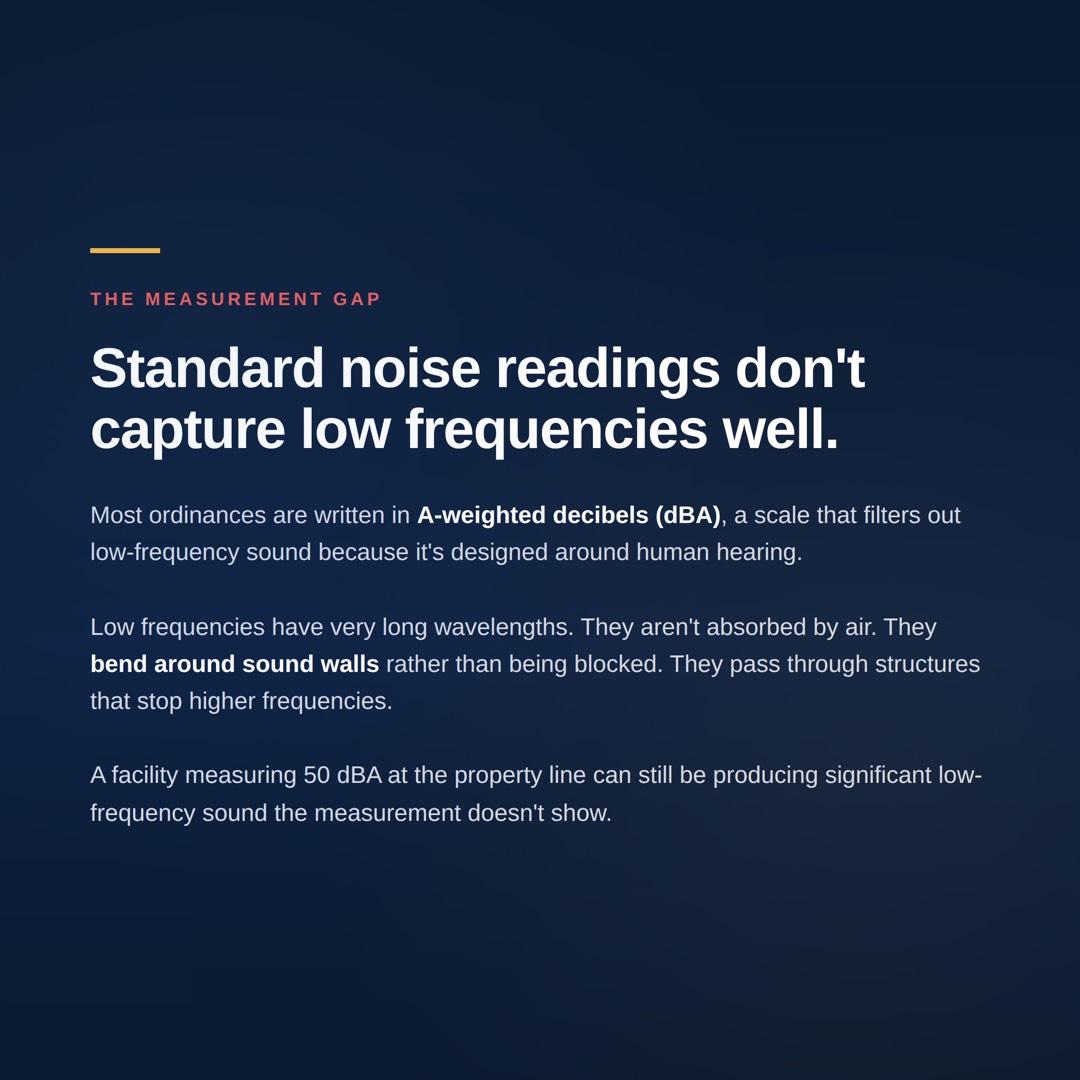
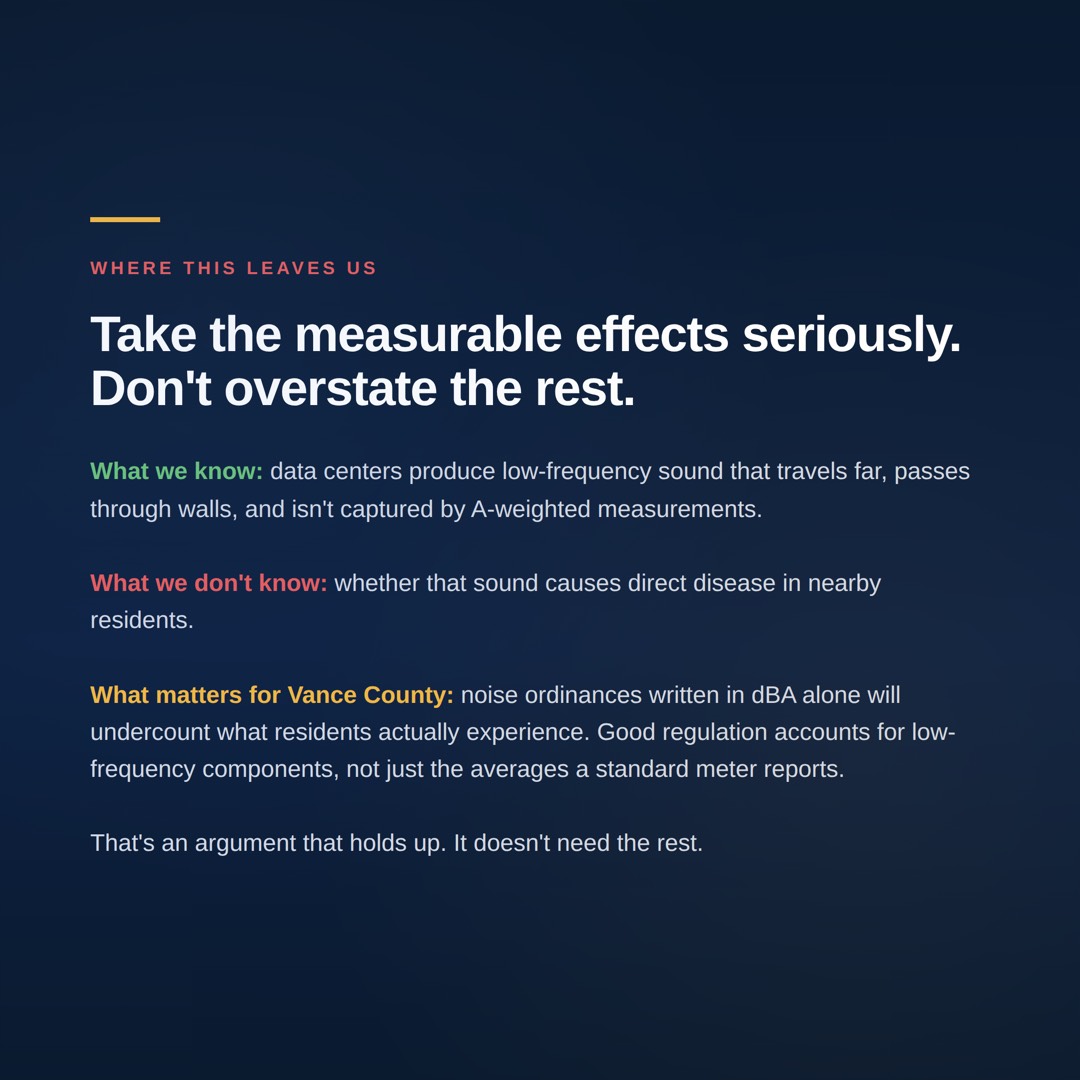
Standard noise measurements use dBA weighting, which filters out frequencies below 20 Hz. This means a facility can comply with every dBA limit while still producing significant low-frequency energy that residents feel. Measuring infrasound requires dBG or dBZ weighting and specialized equipment most jurisdictions do not own or require.
Source: IEC 61672-1 (sound level meter standards); Thorsson et al. (2019) comparison of A-weighted vs. unweighted measurements near industrial facilities
The Best Available Evidence
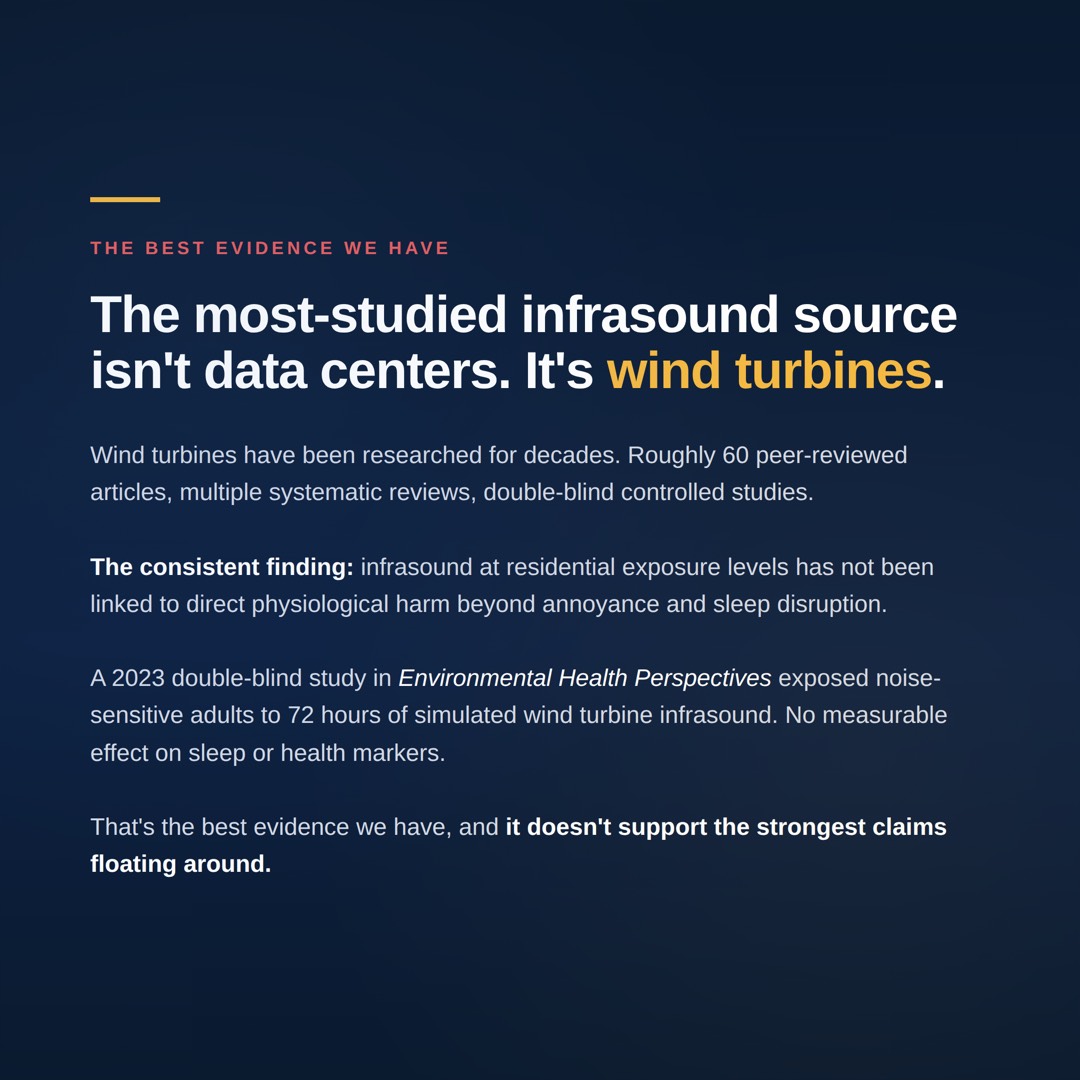
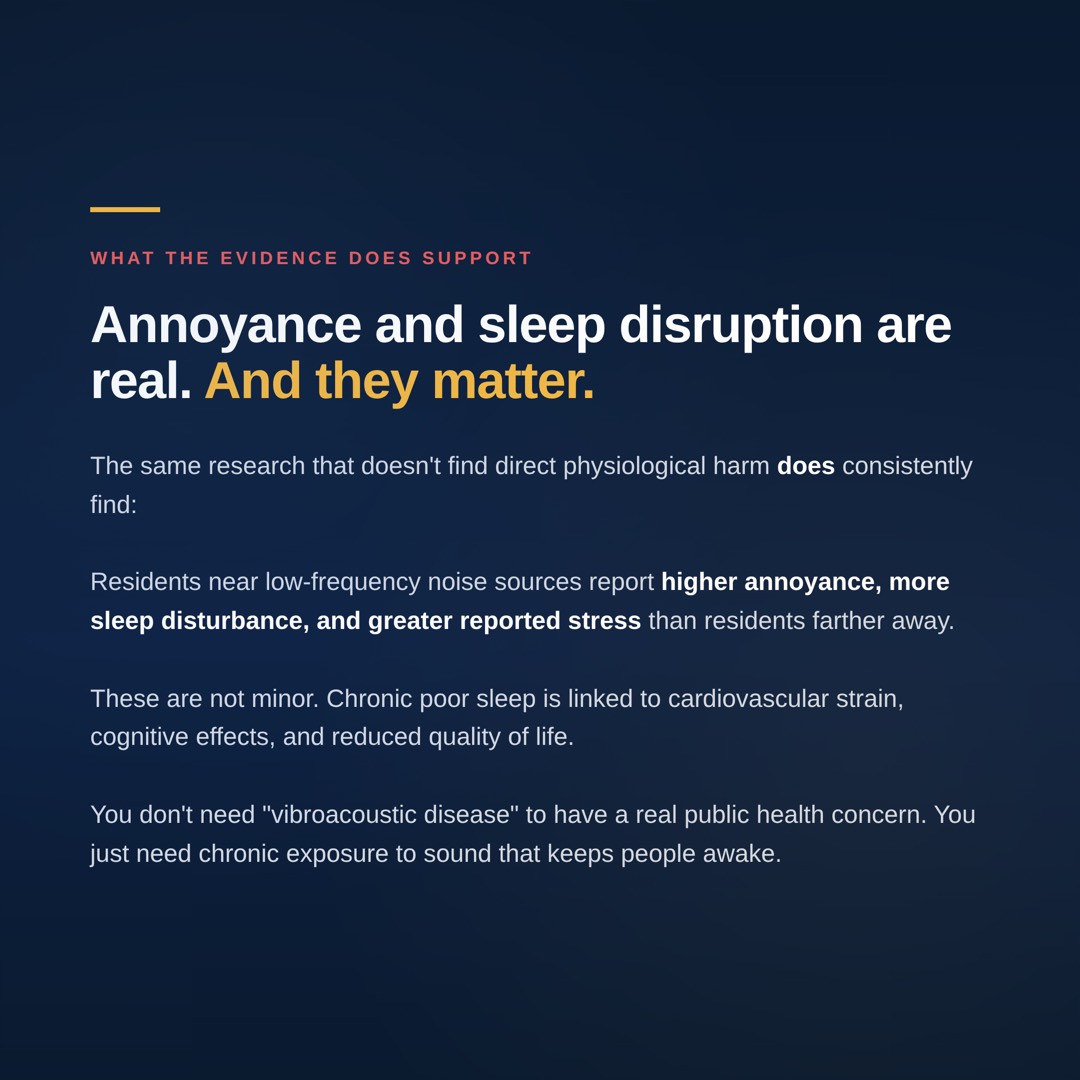
No peer-reviewed studies examine infrasound specifically from data centers. The closest analog is wind turbine research, which has produced roughly 60 studies on low-frequency noise and health effects. The scientific consensus: infrasound at levels produced by industrial equipment does not cause direct physiological harm (no organ damage, no cancer, no cardiovascular disease from infrasound alone). However, the research consistently finds two effects that are real and measurable: annoyance and sleep disruption. These are not trivial. Chronic sleep disruption is linked to cardiovascular disease, metabolic disorders, and impaired immune function.
Sources: WHO Environmental Noise Guidelines (2018); Michaud et al. (2016) Health Canada Wind Turbine Noise and Health Study; Schmidt & Klokker (2014) Health effects related to wind turbine noise exposure: a systematic review; Onakpoya et al. (2015) systematic review of wind turbine noise and health
The Difference
Why Regulation Matters
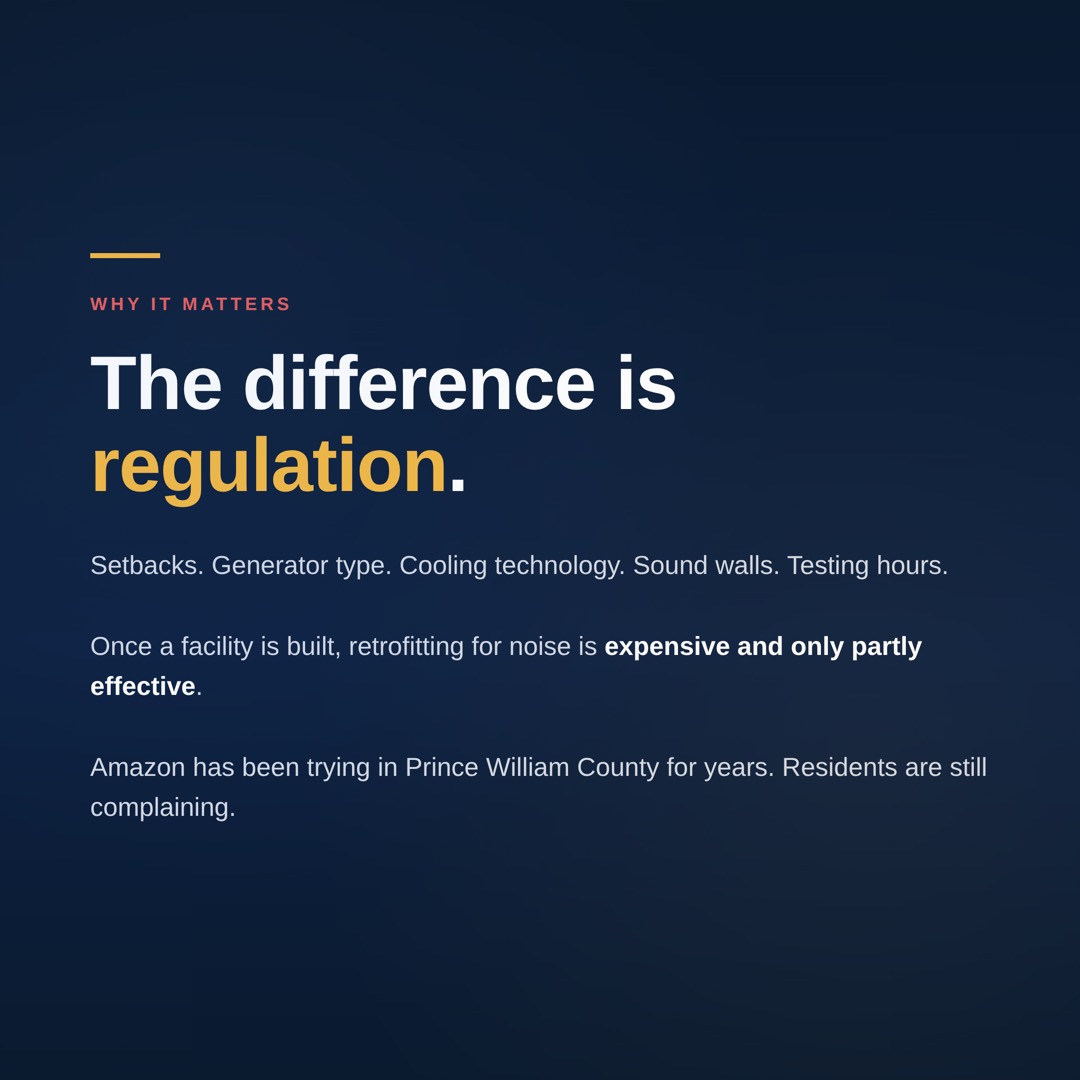
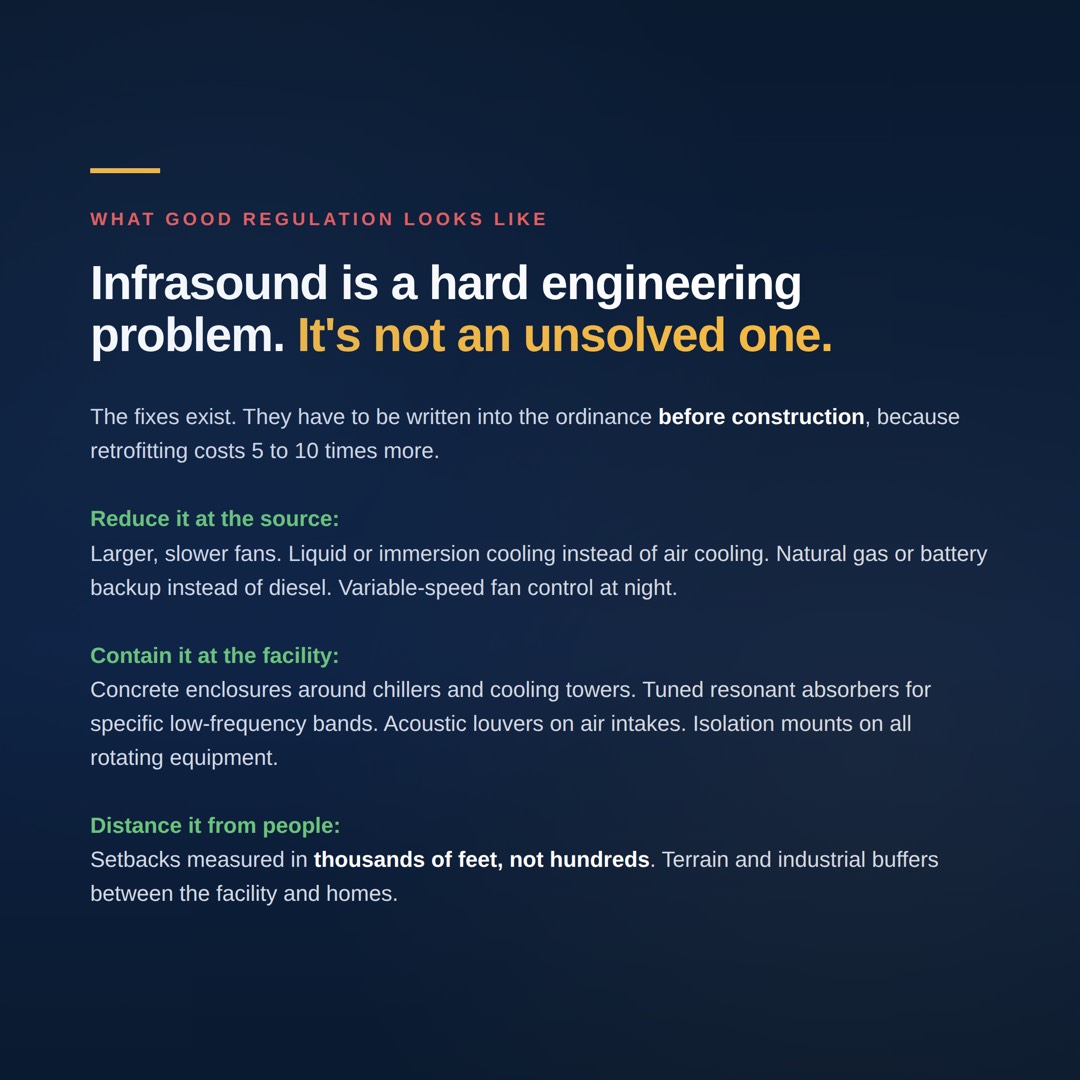
The difference between a data center that is a good neighbor and one that ruins a neighborhood is not the technology. The technology to control noise exists. The difference is whether the county requires it before construction begins.
What Good Regulation Looks Like
- Hard dBA limits at the property line (not at the source), typically 45-50 dBA daytime and 35-40 dBA nighttime
- Low-frequency limits using dBC or dBG weighting in addition to dBA
- Mandatory setbacks of 500-1,500 feet from residential zones
- Pre-construction acoustic modeling submitted with the site plan
- Ongoing monitoring with third-party verification and public reporting
- Enforceable penalties for exceedances, including operational restrictions
Communities That Got It Right
Lea County, NM
Adopted comprehensive data center ordinance before any developer arrived. Requires closed-loop cooling, noise limits, PILOT payments, and decommissioning bonds.
Loudoun County, VA (revised)
After years of complaints, updated zoning to require 50 dBA at residential boundaries, sound barrier walls, and quarterly noise monitoring reports.
Cedar Rapids, IA
Performance-linked incentives: 70% tax exemption only if noise, water, and job targets are met. Community fund of $18M over 18 years.
Sources: Lea County Ordinance 2024-01; Loudoun County Zoning Ordinance Amendment (2023); Cedar Rapids City Council development agreement (2024)
What Vance County Currently Has
Vance County has no data center-specific noise ordinance. No dBA limits at property lines. No low-frequency monitoring requirements. No mandatory setbacks beyond standard zoning. No pre-construction acoustic modeling requirement. No ongoing monitoring provisions. If the rezoning is approved without these protections in place, there is no mechanism to enforce noise limits after construction begins.
Verify Everything
Sources & References
Every claim on this page is sourced. Go straight to the original.
Noise Science & Standards
- NIOSH Occupational Noise Exposure
Decibel scale, hearing damage thresholds
- WHO Environmental Noise Guidelines (2018)
Health effects of environmental noise, recommended limits
- WHO Night Noise Guidelines for Europe (2009)
Recommends <40 dB Lnight outside bedrooms
- EPA Levels Document (1974)
Foundational US noise level guidance, still widely referenced
Infrasound Research
- Michaud et al. (2016) - Health Canada Study
Largest government-funded wind turbine noise and health study
- Schmidt & Klokker (2014) - Systematic Review
Health effects related to wind turbine noise exposure
- Onakpoya et al. (2015) - Systematic Review
Systematic review of wind turbine noise and health outcomes
- ISO 7196:1995
International standard for infrasound frequency weighting
Data Center Noise Reports
Salford University Acoustic Study (2023)
Measured noise levels at UK data center property lines, 45-55 dB well-designed vs 65-85 dB poorly buffered
ASHRAE TC 9.9 Data Center Design Guidelines
Cooling system design, sound-rated equipment specifications
Uptime Institute Generator Testing Standards
Backup generator testing frequency and noise output benchmarks
Community & Policy
- Prince William County, VA
Board of Supervisors noise complaints and QTS campus documentation (2022-2024)
Loudoun County, VA Zoning Amendment (2023)
Updated data center noise limits after years of residential complaints
Lea County, NM Ordinance 2024-01
Comprehensive pre-emptive data center regulation including noise, water, decommissioning
Cedar Rapids, IA Development Agreement (2024)
Performance-linked tax incentives with noise and community benefit requirements
Download
Data Center Noise Report
All the research from this page compiled into a printable PDF. Share it with your commissioners, your neighbors, or bring it to the next meeting.
Download PDF